Thursday, March 3, 2011

Fannie Mae's 2010 National Housing Survey

Fannie Mae has released the findings of their latest National Housing Survey that polled homeowners and renters between October and December, 2010.

The Survey has some interesting facts and figures to digest:  
  • 65% of Americans believe that it’s a good time to buy a home. This is almost unchanged from last January, but down five points (from 70%) that thought it was a good time to buy in June (2010).
  • Just like last year… A large majority (78%) believe home prices have either bottomed or will rise over the next year. However, there have been price declines in most major markets throughout the U.S. over the past year (including here in Minnesota), meaning 78% of people polled in 2010 were wrong.
  • The percentage of those polled who believe buying a home is a safe investment has fallen six points to just 64 percent since last January’s report.

The Center believes that potential homebuyers should ALWAYS be cautious when buying their first home – and be VERY careful when hearing things like “Now is a good time to buy!” and “Housing is a safe investment!”… the “Crowd” may not aways be right.


When renters were asked why they wouldn’t purchase a home… their responses are revealing:

  • The #1 reason cited, by almost half of the respondents, was that they believe their credit was not good enough to obtain a mortgage.
  • In addition, the #2 reason, cited by 47% (multiple answers were allowed)… was that they don’t think they can afford both a mortgage and the upkeep of a home.

While the Center applauds renters that approach the idea of homeownership cautiously… there is a way to KNOW if your credit is good enough… and KNOW exactly how much you can afford to purchase – or if purchasing a home is even a good fit for you: We recommend you take a homebuyer workshop! In Minnesota, the state's premier homebuyer (pre-purchase) education curriculum is known as Home Stretch. To learn more about Home Stretch, and other services for homebuyers, visit the Center's website here.

For more information about the National Housing Survey and to see the complete report, visit Fannie Mae's website, here.  

Monday, February 28, 2011

EMHI Lunch & Learn at the Federal Reserve Bank in Minneapolis

The Minnesota Home Ownership Center is pleased to announce that the Federal Reserve Bank of Minneapolis will be hosting an upcoming luncheon training on:


Speakers at the "Lunch & Learn" will include the President of the Federal Reserve Bank of Minneapolis, Narayana Kocherlakota, and Shana M. Ford, M&I Bank Vice-President and Branch Manager for the MN Region on Diversity & inclusion.

Tuesday, April 5th 11am – 1pm
Federal Reserve Bank of Minneapolis

 
Register for Emerging Markets Homeownership Initiative 
Lunch and Learn  in Minneapolis, MN  on Eventbrite


EMHI, the Emerging Markets Homeownership Initiative, is a program of the Minnesota Home Ownership Center designed to increase homeownership opportunities for Minnesota’s emerging markets. The program grew out of the state’s EMHI business plan launched by Governor Pawlenty in 2004.  The goal of EMHI is to promote parity in homeownership rates among Minnesota's diverse populations.  For more information about EMHI or EMHI programming, visit the MN Home Ownership Center's website, here

Thursday, February 24, 2011

Foreclosure Prevention Counseling Works in Minnesota!

The Minnesota Home Ownership Center has released its “2010 Foreclosure Counseling Program Report” that shows that over 12,000 homeowners sought the foreclosure avoidance services of the Homeownership Advisors Network in 2010 and more than half of all homeowners were able to avoid the foreclosure of their home.

At a time when several national news reports are criticizing the effectiveness of foreclosure intervention and loan modification programs, Minnesota once again breaks the trend! No other foreclosure avoidance program in the country can rival Minnesota’s success.

“Counseling services through our statewide network of nonprofit partners are providing meaningful outcomes for communities, lenders, local governments, and most importantly, Minnesota families,” said Julie Gugin, the Center’s Executive Director “We are pleased to report that more than 5,500 families remain in their homes today because of our counselors’ work.”

The report also provides a glimpse into the demographic and financial circumstances of struggling homeowners who sought help from mortgage counselors:
 

Click To Enlarge: The Face of Foreclosure in Minnesota

A PDF of the Infographic is available here.


According to the experiences of those seeking counseling in 2010, personal, mortgage and financial struggles are converging on many homeowners in Minnesota. The experiences reported by owners offer insights, such as:

  • Homeowners are balancing mortgages on less income. The majority of homeowners seeking help faced either a reduction in income (35%) or a total loss of income (25%) since first taking out their mortgage.
  • Mortgages have become unaffordable for many. Almost two-thirds of homeowners seeking counseling dedicated more than 30% of their monthly income to their mortgage – a recognized standard of an unaffordable mortgage. 24% of homeowners reported dedicating more than half of their income to their mortgage payment.

Minnesota experienced over 25,000 foreclosures in 2010 and this rate of foreclosure is expected to continue into 2011. As Minnesotans struggle with their finances amid current economic conditions, the Minnesota Home Ownership Center will continue providing free counseling and support to homeowners seeking help in managing their mortgage. The services are available for free through members of the Homeownership Advisors Network.

If you, or someone you know is struggling with their mortgage, you can connect with your local housing counseling agency here.


Wednesday, February 9, 2011

Payment Changes With a Fixed-Rate Mortgage

I have a fixed-rate mortgage... but my payment just went up.  How can that be?

This is one of the most common questions the Center receives from recent homebuyers who are wondering what's happening...
  • Are they being taken advantage of by their lender?
  • Has their loan been confused with someone elses?
  • Did they sign the wrong paperwork at closing? 

Using the "Ask A Question" form on the Center's website... several homeowners asked this question, leading us to create a video podcast of the possible answers:


This short video, just six minutes long, gives an overview of how a monthly mortgage payment can change - even if someone has a fixed-rate mortgage.

This is the kind of information that is covered, in-depth, in the Home Stretch workshop.  If you're thinking about buying your first home, think Home Stretch first.

If you've already bought your home... and have a question about your mortgage or your payment, feel free to contact a local housing counselor today!

Tuesday, February 8, 2011

Affordability: Wages and Prices

 This post is a guest post by Laura Hodges, AmeriCorps Member
with the MN Home Ownership Center:

Click To Enlarge
(c) inspidlife (Used Under Creative Commons License)
http://www.flickr.com/photos/soaptrail/

Can you believe we are here in 2011... three years into the worst financial crisis since the Great Depression! Last week a glimmer of hope was announced that joblessness dropped to 9%- the lowest in 2 years.

Although this news inspires hope, many times the national statistics don’t include local information – a community-by-community breakdown - which can led to some people feeling that the lack of sustainable housing and wages isn’t trickling down to their communities. But now there is an interactive, online tool that shares all of this information.

As you may know the Center’s commitment to successful home ownership is demonstrated in many ways including sharing relevant training for the Homeownership Advisors Network, and keeping updated on legislative issues that affect homeownership. As another show of this continued commitment Center staff attended the sponsored by the Minnesota Housing Partnership (MHP), Housing Policy Showcase on January 28th. Presenters included Mary Tingerthal, Minnesota Housing Commissioner, who spoke about her commitment to have Minnesota be a national leader on housing related issues, and Leigh Rosenberg, MHP Manager of Research and Outreach who presented on the connection between housing and wages.

Leigh also launched a valuable new tool that has been developed by MHP that gives a breakdown of housing and wages for every legislative district in Minnesota.

Follow the link and look for your district, and let us know how your district is doing…. http://mhponline.org/policy/policystate/legislative-district-profiles  

If you’re not sure which legislative district you live in, click here.

-- -- -- -- -- --

If you'd like to communicate with Laura, she can be reached via email, here.

Tuesday, February 1, 2011

What does your home of the future look like?


(Click To Enlarge)

Where do you want to live when you grow older? 

For most of us, the answer is "at home." A new exhibition that opens on February 5th at the Goldstein Museum of Design looks at what a future “home” may look like as the population ages, and more of us decide we want to “age in place”.

The “Smart House, Livable Community, Your Future” exhibition, hosted by Housing Studies professor, and MN Home Ownership Center Board Member, Marilyn Bruin and Masters student Jodene Riha will explore the development of new products, technologies and design elements that will allow people to stay in their homes longer as they age.

The exhibition actually walks you through a home inhabited by fictional, 65-ish homeowners, Jim and Sarah, who have recently renovated their 1960s home so that they can continue to enjoy their active, engaged lifestyle. Visitors are actually encouraged to try out (hands-on) all of the items in the home.  Visitors can sit in a power-lifted chair, handle easy-to-use-kitchen utensils, scoot around the kitchen on a wheeled chair to try out lower counters, operate an easy-open window, sit in a fully-adjustable desk chair at an ergonomically-designed desk, and observe wall colors and lighting that ameliorate the impact of changing vision. The bath will feature a walk-in shower and reinforced wall for grab bars. Visitors will learn about a Fall Guard alert system, auto-dispensers for medications, special environmental controls, and tools and technologies that allow Jim and Sarah to do the activities they enjoy and keep them connected to the world.

The exhibition runs from February 5th through May 22nd, 2011. There is an opening party being held on Friday, February 4th from 6-8pm at 241 McNeal Hall, 1985 Buford Avenue in St. Paul. For additional information, visit the Goldstein Museum of Design website here.

Monday, January 24, 2011

NEO: The Matrices Have Been Updated

The Minnesota Home Ownership Center strives to provide information and resources that will assist Minnesotans begin, and maintain, home ownership. 

In November of 2009 we introduced our "Entry Cost Assistance Matrix" that outlines the down payment programs, closing costs assistance and other funds available to first-time buyers in Minnesota. We've now updated the Matrix for the first quarter of 2011! To view the most recent version of the matrix, click here.

The Matrix is organized geographically, which allows readers to quickly find the area of the state that they are most interested in.

As a quick reminder, funding for down-payment assistance and entry-cost help is FLUID. The information may change. Please contact a program administrator to see if funds are available, and, if not, if there is a waiting list that you or your client can use to access funds in the future.

In addition, the Center has also updated its "Affordable Loan Product matrix".   The Affordable Loan Product Matrix is designed to inform housing counselors and industry professionals of affordable mortgage loans and programs available to their clients.

Home ownership is expensive and first-time buyers should never base their home-buying decision on a down-payment program or access to a specific mortgage. There are MANY other factors when deciding whether home ownership is right for YOU or not. Before purchasing YOUR first home... take a Home Stretch Workshop (pre-purchase education workshop) to learn what's involved, and speak with a non-profit Housing Counselor to see if you might qualify for any down-payment assistance or other first-time buyer programs. For more information, click here.

Thursday, January 20, 2011

Pre-Foreclosure Notices Increase 8% in 2010

The Minnesota Home Ownership Center has compiled the pre-foreclosure notices received by the Homeownership Advisors Network (statewide network of housing counseling agencies) through the end of 2010 and the numbers continue to show that Minnesota households are struggling with mortgage payments even as other signs point to an overall improved economy.

For the year, the number of pre-foreclosure notices issued by foreclosing entities statewide increased 8% (Eight Percent) in 2010 over 2009, from 66,570 to 71,665. In the Twin Cities metro area, the number of notices received increased by 1,334, a 3% increase over 2009.

Homeowners in Greater Minnesota seem to be struggling more, as the number of pre-foreclosure notices issued increased FIFTEEN PERCENT. 3,761 more households received notice in 2010 (28,522) than in 2009 (24,761).

On a brighter note, the rate of increase has slowed and in the Twin Cities the trend has almost leveled off. Whether this signals a possible decline in pre-foreclosure notices to be received in 2011 remains to be seen.

Minnesota households received a total of 71,665 notices in 2010:

(Click To Enlarge)

Here's the breakdown for the number of pre-foreclosure notices received by members of the Homeownership Advisors Network in the 7-County Metro Area:


(Click To Enlarge)


However, the rate of increase appears to be slowing, especially in the Twin Cities Metro:

(Click To Enlarge)


(Click To Enlarge)


The overall numbers make it hard to forecast anything but continued foreclosure activity and continued struggles for Minnesota families.


Minnesota State law (MN Statute 580.021) requires that the foreclosing party provide information regarding foreclosure prevention counseling services to the mortgagee (homeowner) AND provide the homeowner’s name, address, and most recent known telephone number to an approved member of the Homeownership Advisors Network- BEFORE filing the notice of pendency.

As always... if you, or someone you know, is struggling with your mortgage payments - or think you might fall behind soon - don't wait! There is a network of non-profit agencies that can help. Contact them today. For additional information about foreclosure prevention in Minnesota - visit the Center's foreclosure prevention resource page here.


Thursday, January 6, 2011

Mortgage Success: Does the Bank Matter?

New study from Ohio State University finds banking locally can impact mortgage success.

Researchers from the John Glenn School of Public Affairs at Ohio State University have found that low-income homeowners who received a mortgage from a local lender were less likely to default on their loans than those homeowners who borrowed from a more distant bank or mortgage company, even when these borrowers received the same type of mortgage product.
The researchers studied loan performance of more than 20,000 homebuyers who purchased homes AFTER the foreclosure crisis began (between 2005 and 2008). They examined the location of bank branches relative to where the homebuyers purchased their homes and found that higher-risk homebuyers with loans from banks with branches close to their new homes (less than 10 miles) were significantly less likely to default on their mortgages.

Can a personal relationship affect loan repayment?
As with large, non-local banks and many mortgage brokers, most local lenders base their lending decision on ‘the numbers’ like credit scores. HOWEVER, many local lenders place more weight on other factors, such as length of current employment, and whether you make regular deposits in a savings account.

“This kind of information may give a more complete picture of whether a person can really afford a mortgage, particularly for higher-risk borrowers,” said Stephanie Moulton, one of the researchers from Ohio State University.

“Some of the local bankers told me they won’t even look at a credit score until they have talked to an individual and determined if they think he or she can make the payments.”, she added.

The researchers believe that if there’s an existing business/personal relationship, the borrower may feel more obligated to make their payments, and the banks may provide more education and information to the borrowers, equipping them to be better homeowners.

The Minnesota Home Ownership Center truly believes that arming potential homebuyers with the ‘education and information’ that Moulton mentions is THE KEY to long-term successful homeownership. There is an entire chapter of the Home Stretch curriculum dedicated to helping potential homeowners navigate the mortgage loan process… including how to choose a lender and a loan product. For more information, visit the MN Home Ownership Center’s website, here.


$600k For Housing Counseling

Homeownership Advisor Network Members Receive almost $600k in HUD Grants

The Minnesota Home Ownership congratulates members of the Homeownership Advisors Network who have received over $638k in funding from the U.S. Department of Housing and Urban Development (HUD). These funds will support the delivery of a wide variety of housing counseling services to help individuals and families in Minnesota improve their access to affordable housing, expand their homeownership opportunities, and avoid foreclosure and foreclosure rescue scams.

HUD Secretary Shaun Donovan stated, “Now, more than ever, it’s crucial that we support these agencies that are working with struggling families on a one-to-one basis to manage their money, navigate the home-buying process, and secure their financial futures.”

In Minnesota, the distribution of these funds will support:

ANOKA COUNTY COMMUNITY ACTION PROGRAM, INC (Blaine), $37,949.74
ARROWHEAD ECONOMIC OPPORTUNITY AGENCY, INC. (Virginia), $41,391.11
CARVER COUNTY COMMNITY DEVELOPMENT AGENCY (Chaska), $39,916.24
COMMUNITY ACTION DULUTH, $41,882.73
DAKOTA COUNTY COMMUNITY DEVELOPMENT AGENCY (Eagan), $61,882.73
LUTHERAN SOCIAL SERVICES/ CCCS OF DULUTH, $110,899.48
REVERSE MORTGAGE COUNSELORS, INC (St. Paul), $35,983.25
SAINT PAUL DEPARTMENT OF PLANNING AND ECONOMIC DEVELOPMENT, $89,832.47
TRI-COUNTY ACTION PROGRAM, INC. (Waite Park), $35,000.00
TWIN CITIES HABITAT FOR HUMANITY (Minneapolis), $35,500.00
WASHINGTON COUNTY HOUSING AND REDEVELOPMENT AUTHORITY (St. Paul Park), $62,865.98


Over $150k of the grant awards listed above were granted as Mortgage Modification and Mortgage Scams Assistance dollars that will be used by organizations to provide homeowners information about fair lending abuses and mortgage ‘rescue’ scams. Ed Nelson, spokesman for the Minnesota Home Ownership Center stated, “These funds will go a long way to helping the counseling agencies spread the word about dangerous, and costly, foreclosure rescue scams in Minnesota.”

The Homeownership Advisors Network is the State of Minnesota’s premier network of housing counseling agencies and is supported by the Minnesota Home Ownership Center. Members of the Homeownership Advisors Network are highly trained, certified professionals that provide advice and guidance for Minnesota families as they struggle to find and maintain stable housing.

For more information about the Homeownership Advisors Network or the statewide media campaign known as “Look Before You Leap” that continues to warn Minnesota homeowners to be on the lookout for foreclosure rescue scams, visit the Minnesota Home Ownership Center’s website at www.hocmn.org

In addition to the funds listed above granted to members of the Homeownership Advisors Network, other organizations in MN also received HUD grants:

CATHOLIC CHARITIES DIOCESE OF ST. CLOUD, $44,340.85
SOUTHERN MINNESOTA REGIONAL LEGAL SERVICES, INC. (St. Paul) 45,324
HOUSING PRESERVATION FOUNDATION (Supports National Network) $2.4mm


Wednesday, December 29, 2010

Stopping Foreclosure Scams: New FTC Rules Take Effect Today

Beginning today, homeowners in Minnesota and nationwide are benefiting from the Federal Trade Commission (FTC)'s new consumer protection rules aimed at stopping foreclosure rescue scams. The Mortgage Assistance Relief Services Rule (MARS) bans companies from making false promises in their marketing and, beginning Jan. 31, prohibiting them from charging any up-front fees for their services.

We are all well aware that these terrible scams are robbing homeowners of their savings, their home, or sometimes both. This new Rule will further our fight to end foreclosure rescue scams in Minnesota by giving the FTC the tools needed to crack down on scamming companies across the country - companies that are targeting homeowners in our state.

In addition, MARS requires mortgage modification companies to disclose key information to consumers, including:
  • They must explicitly state that they are not associated with the government, and their services have not been approved by the government or the consumer’s lender;
  • The lender may not agree to change the consumer’s loan; and
  • If companies tell consumers to stop paying their mortgage, they must also tell them that they could lose their home and damage their credit rating as a result of this action.
For additional information about the new rules, and what it means for Minnesota homeowners, see our full press release, here.

While the new FTC Rule is an enormous consumer protection victory, homeowners still must be armed with information to recognize these scams and to protect their homes. That's why the Minnesota Home Ownership Center has created a brochure-size, two-sided consumer education piece for you to share with your networks and consumers. It equips homeowners with simple questions to ask themselves when considering outside help for a mortgage modification, and it directs them to www.LookBeforeYouLeap.org to connect with a counselor in their community.

Order Look Before You Leap Consumer Handouts Today!

Help us help Minnesota homeowners - commit to displaying this piece today! The consumer handout is the perfect size for brochure and information racks, tabling events, or including in utility bills or other mailings. We have produced materials in both English and Spanish. And, we'll provide you copies free of charge!  Visit the campaign website: www.LookBeforeYouLeap.org to download and submit an order form.

Wednesday, December 22, 2010

Foreclosure Counseling Proven Effective - Again

Back in November of 2009, the Washington Post had a headline proclaiming: "Counseling Helps Borrowers Avoid Foreclosure," citing a report of a study conducted by the Urban Institute of Washington D.C.

Now, thanks to a new report from NeighborWorks America on the "National Foreclosure Mitigation Counseling Program Evaluation: Preliminary Analysis of Program Effects," we can once again state that COUNSELING WORKS.

The National Foreclosure Mitigation Counseling (NFMC) program is a federally-funded program that is designed to support the rapid expansion of foreclosure intervention counseling in response to the nationwide foreclosure crisis.  MN Housing (Finance Agency) has been a recipient of NFMC funds... that support the work of the MN Home Ownership Center's network of non-profit Foreclosure Counselors.

The analysis presented in the report is based on a sample of close to 180,000 loans held by homeowners that received NFMC-funded foreclosure prevention counseling.  Here are just some of the findings:

  • The NFMC program was effective at helping homeowners cure an existing foreclosure. During the first two years of the program, the relative odds of counseled homeowners curing their foreclosure were 1.7 times greater than if they had not received NFMC counseling. The resulting difference in the cure rate means that an estimated 32,000 more NFMC clients cured their foreclosure by the end of December 2009 than would have occurred without receiving services from NFMC counselors.
  • Loan modifications received by NFMC clients resulted in significantly lower monthly mortgage payments than would have been received without the help of the program. Lower monthly payments may help reduce the likelihood of a subsequent recurrence of borrower mortgage problems. On average, we estimated that NFMC clients who received loan modifications in the first two program years reduced their monthly payments by $267 more than they would have without NFMC counseling.
  • Homeowners who obtained a loan modification that allowed them to cure an existing serious delinquency or foreclosure were much more likely to remain current on their mortgage if their loan modification was obtained with help from NFMC counseling. For clients counseled in 2008, counseling produced a 45 percent increase in the relative odds that a post-counseling modification would be sustained through 2009.
 
There are many more advantages to Foreclosure Counseling cited in the full report.
 
Here in Minnesota, research conducted by the Federal Reserve Bank of Minneapolis showed that Foreclosure Counseling cost just under $400 per household -  $400 to save homeowners an additional $3,204 per year, improve their odds of curing foreclosure and increase the long-term success of a modification... plus many other 'intangible' benefits... seems like Foreclosure Counseling is a great investment in long-term housing stability for MN Families.
 
If you or someone you know is struggling with mortgage payments, help is available.  Visit the MN Home Ownership Center's website for more information.

Wednesday, December 15, 2010

Shopping For A Mortgage

According to a LendingTree/Harris Interactive survey released on December 14th, about 40% of recent home buyers obtained JUST ONE mortgage loan quote before purchasing their home.

According to the survey of just over 1,300 buyers, 70 percent of borrowers find shopping for a mortgage frustrating, citing the complexity of the terms as the number one reason people choose not to 'mortgage shop'.

The survey also reveals that although buyers recognize that their mortgage choice is a decision that will affect them financially for the next 15 – 30 years (or more!), nearly three-quarters (72 percent) of homeowners spent less than eight hours shopping for their home loan. Even more shocking? One in ten spent less than TWO MINUTES shopping for their loan.

In Minnesota... buyers have the opportunity to take a Home Stretch workshop, the homebuyer workshop recognized nationally as a proven tool to prepare homebuyers to be successful homeowners.  There is an entire section of the Home Stretch workshop dedicated to fully understanding mortgage loan terminology, how to shop for a loan, how credit affects loan payments and how to avoid being taken advantage of when choosing a loan.

In a forthcoming report from the MN Home Ownership Center, Home Stretch participants reported that help with understanding mortgages and the loan process was the MOST HELPFUL part of the workshop.  One more fact (just in case you're not convinced yet)... NINETY-FIVE PERCENT of Home Stretch participants reported that their participation in Home Stretch will help in the process of buying a home.

Are you thinking of purchasing a home in Minnesota?  You can learn more about the mortgage loan process - - and the entire home buying process by taking a Home Stretch workshop.  For more information, click here.

Monday, December 13, 2010

Update on Minnesota's Homeownership Gap

This post is a guest post by Dr. Kim Skobba, a research and communications consultant that works with the Minnesota Home Ownership Center on Affordable Housing issues and housing policy.  Dr. Skobba publishes her own blog at http://housing-sense.blogspot.com/

___________________________

Update on Minnesota's Homeownership Gap

At 73.7%, Minnesota maintains the highest overall homeownership rate in the nation. When it comes to the rate of homeowners of color, Minnesota does not fare as well. The rate of homeownership among emerging markets is 43.3% - representing the 5th largest gap in homeownership rates in the nation.

[Last] week at the EMHI Summit, Michael Grover (Federal Reserve Bank of Minneapolis) and John Patterson (Minnesota Housing) provided a summary of their research on trends in emerging market homeownership. Their analysis of American Community Survey and Home Mortgage Disclosure Act (HMDA) data identifies some apparent trends and offers a few unexpected findings.
  • The rate of emerging market homeownership declined for the first time since 2000. The rate of homeownership among emerging markets held relatively steady (at about 46.5%) during 2006-2008, which was surprising given the foreclosure crisis and what is known about its affect on minority homeowners. In 2009, the emerging market homeownership rate declined to 43.3%.
  • Some sub-groups of African Americans experienced particularly significant declines in their rates of homeownership. Those in the 45 to 54 age group saw a decline from 46% to 31% and those with a family income between $40,000 - $60,000 experienced a decline from a rate of 57% to 32%. Grover stated that more analysis is needed to make sense of these changes.
  • Minnesota Housing's affordable loan and entry cost assistance programs are helping emerging markets buyers. In 2009, nearly one-third of Minnesota Housing's loan originations were to emerging market buyers, compared to 10.9% in the overall market.
  • Subprime lending among emerging markets is on the decline. The rates of subprime lending (purchase and refinance) dropped from a high of over 40% in 2006 to well below 10% in 2009. Not much of a surprise but good news nonetheless.
The Emerging Markets Homeownership Initiative (EMHI) Summit is an annual event hosted by the Minnesota Home Ownership Center. This year's summit provided the opportunity to learn about the status of emerging market homeownership and some of the current issues facing emerging market homebuyers. Materials from this year's EMHI Summit (including the Grover and Patterson presentation) are available on the Center's EMHI webpage.
___________________________

This post was originally published on Dr. Skobba's blog: here.
Reposted with permission.

Thursday, December 2, 2010

Filling the Foreclosure Funding Gap

The Good News:
Minnesota Housing announced a $1 million award to the Minnesota Home Ownership Center yesterday during a press conference held at a foreclosed property on Saint Paul’s east side. The award comes at a critical time when federal funding gaps threaten the ongoing work of 74 counselors across the state.

Coverage of the press conference can be seen here (Fox-9), here (Finance & Commerce) and here (MPR).
UPDATE: Star Tribune has also covered us: here.

“We’ve come too far and invested too much in foreclosure prevention across the state to let this funding gap damage our efforts and the infrastructure we’ve built together,” said Dan Bartholomay, Commissioner of Minnesota Housing. “Minnesota has benefited from a strong, statewide network of foreclosure counseling agencies, counseling nearly 16,000 households in 2009, and we’re here today to make sure that continues.”

Here's the situation... the foreclosure counseling network in Minnesota faces an immediate threat to the provision of services, even while facing continued, and in some areas, increased, demand foreclosure prevention counseling. Current funding has been exhausted and the next round of federal funding will not be available until March 2011, pending congressional authorization.

“Minnesota Housing has demonstrated outstanding leadership throughout this prolonged foreclosure crisis,” added Julie Gugin, Executive Director of the Minnesota Home Ownership Center. “Their latest contribution will help ensure that tens of thousands of Minnesotans have access to quality, nonbiased services that will help them avoid foreclosure. Their partnership is critical to stabilizing housing and communities throughout Minnesota.”

With this $1 million award, the Minnesota Home Ownership Center is prepared to work directly with counseling organizations to continue services.

The Bad News:
Center staff has calculated that it will take just over Five Million dollars to cover the cost of maintaining foreclosure counseling services in the state of Minnesota at current levels through the end of 2011.  We'll keep you informed about the fundraising process - and its impact on the counseling network over the coming months. 
 
For now... services will continue without interruption and MN Homeowners that are struggling with their mortgage payments - or think they may have difficulty making payments soon, should contact a non-profit (FREE!) foreclosure counselor TODAY.

Tuesday, November 30, 2010

NEW Foreclosure Prevention Service Map

Over the past few years of the foreclosure crisis in Minnesota, both housing industry professionals and social service agencies have requested an easy-to-use map of service areas covered by the Center's network of foreclosure counseling agencies... that they could print out and keep handy.

Now, the Center has produced a new printable map showing foreclosure counseling services provided by the Homeownership Advisors Network and the geographic or language service area they cover. This map is intended to be a reference tool for professionals as a supplement to the interactive online map.


(Click To Enlarge - Use Link Below For High Quality Print Version)

The map is available for download (print) here

The same information is also available in an interactive format here.

There are also other resources (including fact sheets, presentations, newsletters and more) available for professionals that may be working with struggling homeowners at the Center's website here.

Foreclosure prevention counseling services are provided free of charge by nonprofit housing counseling agencies working in partnership with the MN Home Ownership Center. Remember: there is no need to pay a private company for these services!  For more information an avoiding foreclosure, visit the Center's website.

Tuesday, November 23, 2010

Moving? Where are you going?

I came across a great interactive map from Forbes the other day (yes, they published the map a few months ago... but the information is great).  If you click on any county on the map it will show you the inbound and outbound movement for that county... including lines that show where people are moving to and from.

On the map... RED lines show the out-migration* from the county and in-migration* is shown in DARK GREY/Black for households that moved in 2008While the data is a few years old... there's no reason to think that the trend would have changed too dramatically in the last year and a half.

As an example, here's the migration map for Ramsey County:


(Click To Enlarge)

If you want to see a REALLY scary picture... click on Detroit (Wayne County, MI).

The interactive map is here.


*NOTE:  I've chosen to use the terms out-migration and in-migration instead of Emigration and Immigration... as those terms tend to refer to movement outside/into the country. The movements represented on the Forbes map show the movement of US residents only to and from OTHER US counties.

Monday, November 22, 2010

Center Board Member Recognized: Top Woman in Finance

The Minnesota Home Ownership Center is proud to publicize the fact that Muffie Gabler, long-time Center board member, has been recognized by Finance and Commerce as one of only 50 “Top Women in Finance” in Minnesota. In addition, Muffie was chosen to join Finance and Commerce’s “Circle of Excellence” as she had previously been honored as a Top Woman in Finance in 2007.

The Top Women in Finance award is given to principals, partners, executive vice presidents, CFOs, CEOs and managing directors at not only financial institutions and lenders but also leaders of businesses small and large throughout Minnesota who have shown innovation, leadership, or some other notable qualities in the area of finance.

In addition to being one of the principal drivers of the creation of the Minnesota Home Ownership Center, Muffie has been an integral part of the Affordable Housing arena in Minnesota and countless affordable housing initiatives and community development projects would never have gotten off the ground without Muffie’s assistance.

Winners were recognized during a dinner and program on November 10th at the Hyatt Regency in Minneapolis. For a complete list of honorees, visit the Finance and Commerce article here.

Thursday, November 18, 2010

Pre-Foreclosure Notices Continue Unabated

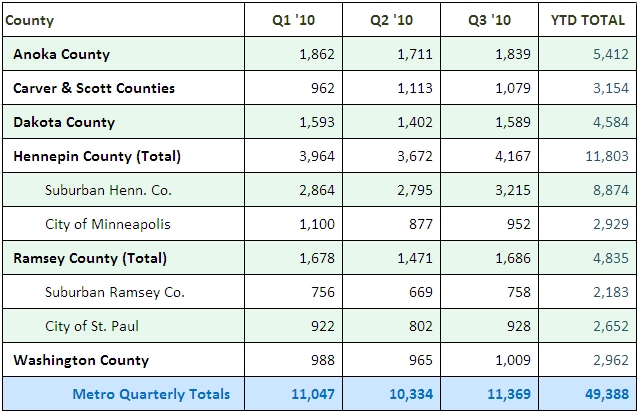
The Minnesota Home Ownership Center has compiled the pre-foreclosure notices received by the statewide network of Housing Counselors through the end of the third quarter (September)... and the upward trend continues!

The most recent quarter (July through September) recorded the second-highest number of pre-foreclosure notices since the MN legislature enacted the notices in the third quarter of 2008.  Year-To-Date, the total number of pre-foreclosure notices received has now exceeded 54,000.

(Click To Enlarge)

Here's the breakdown for the number of pre-foreclosure notices received by members of the Home Ownership Advisors Network in the 7-County Metro Area:

(Click To Enlarge)


NEW:  For the first time since the Center started tracking and publishing the pre-foreclosure notice totals in June of 2009, we are now tracking the running quarterly totals of notices received to see where the trend is heading: 

(Click To Embiggen)


This information makes it hard to forecast anything but continued foreclosure activity and continued mortgage difficulties for Minnesota families.  As always... if you're struggling with your mortgage payments - or think you might fall behind soon - don't wait!  There is a network of non-profit agencies that can help.  Contact them today.  For additional information about foreclosure prevention in Minnesota - visit the Center's foreclosure prevention resource page here.

Are HAMP Improvements Possible?

On Wednesday, November 17th, MN Senator Franken joined 17 other Senators in sending a letter to Treasury Secretary Timothy Geithner asking for immediate changes to the HAMP program to help homeowners facing foreclosure. 

The complete letter is here. (PDF Document)

Here are some of the key steps the Senator(s) recommend implementing in order to improve the HAMP program:
  • The creation of the Office of the Homeowner Advocate. This office would focus on assisting homeowners who believe their mortgage servicer is breaking the rules;
  • Provisions that would hold servicers accountable;
  • Automatically extend permanent mortgage modifications if trial modifications are completed successfully;
  • Revise eligibility requirements;
  • Ensure that servicers provide homeowners with necessary documentation; and
  • Provide homeowners with information as to why they have been denied HAMP modification.

The Minnesota Home Ownership Center applauds any and all efforts to assist struggling homeowners... and welcomes your comments as well!
  • Will Senator Franken's suggestions improve the HAMP program?
  • What improvements would YOU suggest to improve the HAMP program?
  • Do you have other suggestions for helping struggling MN homeowners?
Use the comments section to post your suggestions.

Tuesday, November 9, 2010

Fourth Annual EMHI Summit

The Minnesota Home Ownership Center is pleased to announce that the 2010 Emerging Markets Home Ownership Initiative (EMHI) summit has been scheduled for December 8, 2010 at the Continuing Education and Conference Center on the St. Paul Campus of the University of Minnesota.

The Annual EMHI Summit is a hallmark of the Center’s dedication to the EMHI mission of working to promote homeownership parity. This year's Summit will bring together industry and community stakeholders to develop tools, resources, and best practices aimed at increasing homeownership opportunities for Minnesota’s emerging markets.

The agenda will include:
  • A welcome from MN Home Ownership Center Executive Director Julie Gugin;
  • Michael Grover, community affairs manager from the Federal Reserve Bank of Minneapolis, and John Patterson, director of research and evaluation at Minnesota Housing, will provide a comprehensive analysis of the current status of emerging markets homeownership in Minnesota. A traditional part of the EMHI Summit, this presentation will offer thought-provoking insight into the status of emerging markets homeownership and how the current economic environment has impacted effort;
  • Representatives from the industry, including Michael A Haley, of Identity Theft Shield, Nancy Hostetler of Open Door Home Loans (Bell Mortgage) and Roxanny Armendariz of Neighborhood Development Alliance will offer practical insights into client credit issues facing members of emerging markets. Discussions will include credit repair and Fair Issac scoring;
  • Keynote Speaker: Angela Glover Blackwell (Pending)

    Angela Glover Blackwell is a national leader for social justice and equity. She seeks to strenghten America by creating stronger low-income communities and communities of color. A former Sr. vice president at the Rockefeller Foundation, she has appeared on Nightline, PBS's NOW, and is a frequent commentator on public radio's Marketplace and the Tavis Smiley Show. Her articles have appeared in the New York Times, the LA Times and the San Francisco Chronicle.
The Summit is designed primarily for realtors, lenders, non-profits, elected officials, and others working in the homeownership arena, but is open to all.

The Summit is FREE and 3.5 hours of Real Estate CEU credits have been applied for.

REGISTER TODAY: http://emhisummit2010.eventbrite.com

Are you on Twitter?  Help Spread The Word!  Use Hashtag #EMHI10  (EMHI TEN)

Thursday, November 4, 2010

Foreclosure Data - Another Blow

Lender Processing Services has released their most recent version of the LPS Mortgage Monitor, October 2010 Mortgage Performance Observations which contains an informative series of charts and graphs that show that while delinquent and foreclosed loans had stabilized somewhat at the end of 2009 and into the first half of 2010, new problem loans are once again picking up:


(Click To Enlarge)


The graph above shows loans that are currently 60 days or more delinquent but that were current just 6 months ago.  You can certainly see the upswing that started in the middle of 2010.

The LPS report also has some, albeit limited, information regarding Minnesota.  For example, in their table on the Delinquency and Foreclosure Rate, Minnesota ranks 42nd in the nation (that's a good thing!) in percentage of delinquent mortgages:


(Click to Enlarge)

According to the chart, our delinquency rate is about 34% lower than the national average of 9.27%.

Another chart that contains information about Minnesota shows that the average number of days delinquent for loans that are in foreclosure (time delinquent before foreclosure sale) has increased 85% since 2008, and now overages over a year - 386 days to be exact:


(Click To Enlarge)


Not only is it taking lenders/servicers longer to foreclose... the number of foreclosures is starting to increase again.  This problem is NOT going to go away soon.  Thousands of Minnesota families are still struggling every month to make their mortgage payments!  If you, or someone you know is struggling... don't wait, contact a member of the Minnesota Home Ownership Center's network of foreclosure counseling agencies TODAY.  The sooner you call, the more options you have available!

Tuesday, November 2, 2010

Vote Again!

No... the Minnesota Home Ownership Center is not advocating voter fraud!  :-)

We want you to vote on the consumer handout that we plan to produce for our Look Before You Leap campaign.

Look Before You Leap” is a statewide public education campaign seeking to raise public awareness about the booming foreclosure rescue scam industry and its dangerous implications for struggling and unsuspecting home owners, and to connect struggling home owners with the Center’s network of FREE and trustworthy foreclosure counselors.

The piece we are designing will be used in mailings, handouts, counter displays, etc... and we hope to make the piece as attractive as possible so that struggling homeowners see the piece and respond.

Here are the two options:

(Click To Enlarge)


Would you take please take 30 seconds to respond to a quick on-line survey about the piece?  4 questions... 30 seconds... SURVEY HERE  

You can also leave feedback in the comments!  We'll be compiling this information through Friday, November 5th.  THANKS!