Tuesday, March 6, 2012

Manufactured Housing in Minnesota

New Fact Sheet Available!


Used Under Creative Commons License
Foto by Archerland2005
Manufactured homes (often called mobile homes) are built entirely in a factory and have a permanent structure that allows for them to be transported. The homes are usually placed on land owned by the homeowner or leased at a mobile home park.  Mobile home design and aesthetics have changed dramatically in the past few years and most no longer resemble the ‘trailer’ look of years past.  They can be an affordable housing option for Minnesotans, but there are some VERY important considerations to make before you decide to purchase a manufactured home.


For that reason, the Minnesota Homeownership Center has created a new Fact Sheet that covers:

  •  Advantages and Disadvantages to purchasing a manufactured home
  •  Living in a resident-owned or cooperative mobile home park
  •  Financing the purchase of a manufactured home
  •  Steps to take when purchasing


To view the complete fact sheet… and others that can help you in your goal of homeownership, visit the Center’s website, here.


As always the Center highly recommends that if you’re thinking of purchasing your first home in Minnesota, whether manufactured housing or traditional site-built housing, that you first make an appointment with a Homeownership Advisor (Housing Counselor) who will be able to work with you to create a plan to reach your goal of homeownership.  They’ll also help you understand your rights and responsibilities as a homeowner and make sure that you know about any down payment or entry-cost assistance programs you might be able to access.


The Minnesota Homeownership Center exists to promote and advance successful homeownership in Minnesota… speak with a Homeownership Advisor today so that YOU can be successful in the purchase of your first home.  Counseling services are FREE and confidential.


Friday, February 10, 2012

Mortgage Settlement Announced - What it Means for Minnesota


On February 9th, 2012, the Minnesota Attorney General’s office and the Department of Commerce announced that the State of Minnesota would be participating in the Federal Foreclosure settlement with five major lenders/servicers.  These five servicers have agreed to a $26 Billion dollar settlement, through which Minnesota borrowers may be eligible for up to $280 million.


The five lenders are: Ally/GMAC, Bank of America, Citi, JP Morgan Chase and Wells Fargo.  (Nine other servicers may sign on to the settlement later, we’ll update that information as it becomes available.)    It is important to note that loans owned or backed by Fannie Mae and Freddie Mac are not part of the settlement.  However, there are other programs and assistance available to some of these borrowers.  Click here for more information.


Additional information for homeowners interested in learning more about the settlement is available here: http://www.nationalmortgagesettlement.com/.  


REMEMBER:  DO NOT PAY FOR HELP.  No ‘agent’, ‘specialist’ or ANYONE should be charging you to ‘get access’ to the settlement.


WHAT DOES THE SETTLEMENT PROVIDE FOR MINNESOTA?  
Direct Payments to Borrowers.  Minnesota borrowers may qualify for financial compensation:

  • Certain borrowers who lost their home to Sheriff’s Sale between the beginning of 2008 and the end of 2011, may be eligible for financial compensation of approximately $2,000* if they lost their home due to financial hardship AND 
  • They were in the process of seeking a loan modification and the bank proceeded with the foreclosure anyway OR
  • There were documented errors committed by the lender in the foreclosure process.

*The exact amount paid to homeowners will depend on the number of eligible borrowers who file a claim.


Refinancing Benefits. This part of the settlement allows underwater borrowers of mortgages owned by the five banks (as long as they are not backed by Fannie/Freddie) to refinance to a lower interest rate if they are current on their mortgage and have not had any late payments in the last 12 months.  The loan must have been originated prior to January 1, 2009, and have an interest rate of 5.25 percent or more. 


Principal Reductions and Other Relief. This part of the settlement will allow certain borrowers of loans owned, or in some cases serviced, by the five banks to qualify for:
  • a principal reduction of their underwater mortgage and either 30 days late on the mortgage or who face ‘imminent default’;
  • a forbearance  (set period of time with no mortgage payments) for unemployed borrowers, 
  • short-sale assistance, 
  • transitional housing assistance, 
  • and other relief (details to be determined)
Beyond the financial relief and compensation outlined in the settlement, the five banks have also agreed to make substantial changes to their mortgaging and servicing standards including:
  • Processing loan modification requests in less than 30 days
  • Stopping the foreclosure process for homeowners who have a loan modification application pending (as long as the application is processed more than 15 days before the Sheriffs sale)
  • Stopping the  foreclosure process completely for homeowners who are complying with a trial modification (either HAMP or the lenders’ in-house modification)
  • Lenders must process requests for short sales (permission to sell the home for less than the outstanding mortgage loan amount) in less than 30 days.
  • Lenders must assign a single point of contact to homeowners, or their foreclosure prevention counselor, who will be responsible for keeping the homeowner up to date with information about the loan, the modification process and any documentation needed.


WHAT HAPPENS NEXT?  HOW DO I APPLY?
  • Over the next 30 to 60 days, settlement negotiators will be selecting an administrator to handle the logistics of the settlement and monitor compliance. 
  • Over the next six to nine months, the settlement administrator, attorneys general and the mortgage servicers will work to identify homeowners eligible for the immediate cash payments, principal reductions and refinancing. Those eligible will receive letters directly from their lender/servicer.
  • This settlement will be executed over the next three years

The exact details of how homeowners access the settlement are still being worked out.  There are steps you can be taking to make sure that you keep up to date with the settlement:
  1. Contact a non-profit member of the Homeownership Advisors Network.  Foreclosure Counselors will know, as the details become available, the exact steps to take AS WELL AS know if you might qualify for any additional assistance or be able to access other programs to help prevent the foreclosure of your home.
  2. Contact your lender.  If your mortgage is with one of the five current participants in the settlement, visit the National Mortgage Settlement website for links to the banks’ websites and contact telephone numbers.  


Even if your bank is not participating in the settlement, or they are, but your loan is backed by one of the Government Sponsored Entities, it is important that you take steps right away if you are struggling with your mortgage.  Contact a foreclosure counselor TODAY to learn about the WIDE ARRAY of programs, helps and assistance that are available to Minnesota homeowners.  Counseling is FREE and non-biased.  The sooner you call, the more options you have available, and remember, NEVER PAY FOR HELP!

Thursday, February 2, 2012

Another New Refi Program? Get the Facts!


During the 2012 State of the Union Address, President Obama announced another expansion of the federal mortgage refinance program :
That's why I'm sending this Congress a plan that gives every responsible homeowner the chance to save about $3,000 a year on their mortgage, by refinancing at historically low interest rates. No more red tape. No more runaround from the banks. A small fee on the largest financial institutions will ensure that it won't add to the deficit, and will give banks that were rescued by taxpayers a chance to repay a deficit of trust. (From the State of the Union Address)


The current versions of the refinance program (HARP and HARP II) allow homeowners whose loans are owned by Fannie Mae, Freddie Mac or the Federal Housing Finance Agency, to refinance to current historically-low interest rates, EVEN IF the loan value exceeds the value of the home (allows "underwater" homeowners the opportunity to refinance).


On Wednesday, February 1st, the president released additional information about the proposed expansion of the refinance programs:


The proposed program (HARP 3?) would allow ALL homeowners who are current on their mortgage — even those who do not have loans backed by Fannie, Freddie or FHFA and even if they're  underwater on their mortgage — to also refinance their loans.


The proposal put forward by the administration includes some details about the who would qualify:

  • only owner-occupied, single-family homes are eligible.
  • Homeowners must be current on their mortgage and not had a lat payment for at least the past six months; 
  • Homeowners must have a minimum FICO credit score of 580; 
  • The loan amount cannot exceed the current federal conforming loan limit. 

For those who meet the criteria, the program would allow for a streamlined application process in which lenders would only need to confirm that a homeowner is employed and the home would not have to be appraised.


NOW... What does this REALLY mean for the average Minnesota Homeowner who might want to refinance?

  • Even though HARP II was announced in October of 2011, as of early February 2012, very few lenders and servicers have processes and procedures in place for homeowners to take advantage of the refinance program.  Any formal expansion to the program announced today would take MONTHS before a homeowner would likely be able to work out a refinance with their lender.  (See our blog post on the HARP 2.0 announcement in October, here)
  • Most Importantly, this expanded program will require CONGRESSIONAL APPROVAL. Given the fact that we are in a rather contentious election year... approval by congress is far from certain.

We'll continue to monitor this program, and if the program expansion does become a reality, we'll notify Minnesota Homeowners via this blog and our website, here.

Thursday, January 19, 2012

Preforeclosure Notices Continue to Decline in Minnesota


On  Thursday, January 19th, the Minnesota Homeownership Center released its year-end data on the aggregate number of Preforeclosure Notices received by foreclosure counselors in the Homeownership Advisors Network.  The numbers continue to indicate that Minnesota is slowly emerging from the foreclosure crisis.  


In the fourth quarter of 2011, members of the Homeownership Advisors Network received 12,016 preforeclosure notices, 30% fewer than during the same time period in 2010, reaching the lowest level reported since the state legislature required the notices in late 2008:


Click to Enlarge


On a yearly basis, Minnesota households received 24% fewer preforeclosure notices in 2011 than they did in 2010.  

Most encouraging is that the fact that the numbers of preforeclosure notices received is down in every county in the Metro area.  In addition, every agency in the Homeownership Advisors Network reported receiving fewer notices in the fourth quarter of 2011 than in the third, AND reported receiving fewer notices in the fourth quarter of 2011 compared to the same period in 2010.


While these numbers are encouraging, we shouldn’t lose sight of the fact that they still show that more 54,500 households continued to struggle with delinquent mortgages in 2011:


Click to Enlarge


Here's the breakdown for the number of preforeclosure notices received by members of the Homeownership Advisors Network in the 7-county metro area:


Click to Enlarge


As background, Minnesota state law (MN Statute 580.021) requires that the foreclosing party provide information regarding foreclosure prevention counseling services to the mortgagor (homeowner) and provide the homeowner’s name, address, and most recent known telephone number to an approved foreclosure prevention counseling agency before filing the notice of pendency.


Once the Minnesota Homeownership Center's network of foreclosure counselors receives notification from the lender/servicer/homeowners association, they then contact the homeowner, and track the number of notifications received during the month in their monthly reporting to the Center.


If you or someone you know is struggling with their mortgage payment, new programs, resources and assistance are becoming available all the time. Don’t give up… contact a foreclosure counselor that is a member of the Homeownership Advisors Network today to see if there’s help available for you to avoid foreclosure. Even if you’re not yet behind, now is the time to call. To find your local foreclosure counselor, click here.

Wednesday, January 11, 2012

Freddie Mac Announces Expansion of Mortgage Relief Program


Earlier this week, mortgage giant Freddie Mac announced an expansion of its mortgage forbearance program to assist borrowers who are experiencing a financial hardship due to unemployment.


A forbearance is an agreement on the part of the lender or investor to withhold their claim to foreclose on a property - an agreement not to foreclosure for a set period of time.


According to Freddie Mac, their servicers can now offer eligible borrowers a short-term unemployment forbearance period of up to six months plus the possibility of an extended unemployment forbearance period if they remain unemployed for more than six months.  (The six-month forbearance period is 'renewable' for a second six-month period, not to exceed a maximum of 12 months.)  Under previous guidelines, the maximum period was six months.


In addition, this expanded program is now available for unemployed homeowners that are already performing under a HAMP or other loan modification program.  If they continue to be eligible for HAMP or another loan modification program, they will be re-evaluated at the end of the forbearance period.


Freddie Mac has outlined some basic eligibility criteria for borrowers (the full criteria are available in their Single-Family Seller/Servicer Guide (Guide) Sections A65.26 through A65.28, here) that include:

  • Borrower must currently be experiencing an an unemployment hardship;
  • Borrower's current monthly housing expense-to-income ratio (excluding unemployment benefits) must be greater than 31%;
  • Borrower's cash reserves cannot exceed 12 months of their monthly housing expense;
  • Only a borrower's primary residence is eligible. Second homes and investment properties are ineligible.
  • The property cannot be vacant, condemned, or abandoned.

Effective Date

Freddie Mac has strongly encouraged its servicers to begin offering eligible borrowers the unemployment forbearance relief options as soon as possible, but are required to begin offering unemployment forbearance to eligible borrowers no later than February 1, 2012. 


Are you struggling with you mortgage and like to know if an unemployment forbearance - - or other solution - - is right for you?  In Minnesota, the non-profit housing counselors in the Homeownership Advisors Network are available to meet with you FOR FREE to help you with your options to avoid foreclosure.  To find your closest counselor, visit the Minnesota Homeownership Center's website here.

Friday, January 6, 2012

Financial Assistance For Homeowners Displaced By Foreclosure


Due to the success of a pilot program initiated in late 2009 and the generous support of the Otto Bremer and Target Foundations, the Minnesota Homeownership Center announces the availability of financial grants of up to $2,500 to help cover the costs of moving to alternative housing after a foreclosure.  The goal of the grants is to assist Minnesota homeowners with the difficult transition from homeownership back into a rental situation, and to prevent homeowners that were unable to prevent the foreclosure of their home from becoming homeless.


The counselors of the Homeownership Advisors Network (housing counselors) are AMAZING at the work they do to keep homeowners in their homes whenever possible.  However,  foreclosure is inevitable for some families... and these grants allow the members of the network to keep a difficult situation from becoming a tragic one.


Currently, these grants, known as Re-Housing Grants, are only available to qualified homeowners in the City of Saint Paul and Dakota & Washington Counties.  Interested homeowners should contact the Minnesota Homeownership Center for information on how to connect with a member of the Homeownership Advisors Network that is participating in the program.  Teams established by these non-profit counseling agencies will help homeowners determine if they are eligible for one of these grants based on established criteria:

  • The applicant has not previously received a grant from this or a similar program.
  • The Foreclosure Sale has occurred and retaining ownership is unlikely and relocation is needed.
  • limited income and/or excessive but necessary expenses have prohibited the homeowner from saving enough money to secure alternative housing.
  • The full monthly rent payment in the alternative housing will be affordable, long-term, for the applicant.

Homeowners who are interested in learning more are encouraged to contact the Minnesota Homeownership Center at 651-659-9336 or by visiting www.hocmn.org.


UDPATE:  Funding is available for the ENTIRE SEVEN COUNTY METRO!  (Anoka, Carver, Dakota, Hennepin, Ramsey, Scott and Washington Counties).  For information on who to contact, the Center has established a page on their website, here:  http://hocmn.org/en/rehousing.cfm

Friday, December 2, 2011

Fannie Mae and Freddie Mac Eviction Moratoriums

On Thursday December 1st, Fannie Mae and Freddie Mac both announced eviction moratoriums that will take place over the holidays. From December 19 through January 2, families living in properties where a Fannie Mae or Freddie Mac loan has been foreclosed upon will not be evicted.


NOTE:  The legal and administrative processes for the evictions may continue during this time, but families will be able to stay in their homes.  In addition, the GSE's will continue with the foreclosure process on delinquent borrowers during this time period as well.


Large mortgage servicers often follow suit – we will updated this blog if we learn of additional banks or servicers initiating moratoriums. 


There are some nuances to the Fannie and Freddie moratoriums; additional details are available in the press releases here and here.


There is no "cold weather" rule regarding foreclosure or evictions after foreclosure in Minnesota.  If you are struggling with mortgage payments or have questions about the process, contact a FREE non-profit Homeownership Adviser that specializes in foreclosure prevention TODAY.  Waiting limits your options!

Monday, November 14, 2011

Southwest Minnesota Housing Partnership Awarded USDA Housing Preservation Grant


Used under Creative Commons
License.  Photo by  ario_ 
Funding will help maintain housing stock in SW Minnesota


The Southwest Minnesota Housing Partnership (SWMHP) has been selected to receive a $69,000 Housing Preservation Grant through USDA Rural Development. The grant will be used to assist 11 very-low and low-income households in the cities of St. James, Sleepy Eye, Winthrop, Gibbon and New Auburn make essential improvements and repairs to their homes.


SWMHP is a member of the Center's Homeownership Advisors Network and offers Home Stretch workshops and counseling, refinance counseling and foreclosure prevention services in dozens of counties in Southwest Minnesota.


The Housing Preservation Grant program provides funding to intermediaries such as town or county governments, public agencies, federally recognized Indian Tribes, and non-profit and faith-based and community organizations. These organizations then distribute the grants to homeowners and owners of multi-family rental properties or cooperative dwellings who rent to low- and very-low-income residents.  


Grants may be used to make general repairs, such as installing or improving plumbing or providing or enhancing access to people with disabilities. Funds may also be used to weatherize and make homes more energy efficient.


To learn more about the Southwest MN Housing Partnership, visit their website at http://www.swmhp.org/.  


Improvement and rehab programs available through the Southwest MN Housing Partnership are included in the Center's "Repair and Rehab Matrix" that we've created as a resource listing improvement, rehab and repair programs in local communities throughout the state.  Programs included in the Matrix include:
  • emergency repair, 
  • energy efficiency, 
  • lead hazard abatement, and 
  • general repair. 


Some funds are grants and others are loans, usually with below market interest rates.  Looking for help with repair or rehab on your home?  Visit the matrix page of the Center's website here: http://www.hocmn.org/en/rehab.cfm


Wednesday, November 9, 2011

Racial Disparities in Assets and Homeownership


© Mullica
Disparities in Minnesota continue to rise


The Minnesota Budget Project has reported that according to the American Community Survey (ACS) released by the U.S. Census Bureau last month, not only is poverty increasing in Minnesota, but disparities in poverty levels and household incomes between communities of color and whites are worsening. While the 2010 ACS reports that just under 12% of Minnesotans were living in poverty, the percentages according to race reveal a marked difference in poverty levels for communities of color--the highest being for American Indians which grew from approximately 31% in 2007 to just under 40% in 2010. Likewise, the median household incomes for Latino, black, and American Indian communities remain substantially lower than the statewide median household income for whites. Minnesota has historically suffered from racial disparities and, unfortunately, the latest reports do not hint towards the end of that plight. 


On a national level, Minnesota’s averages rank on the better end for overall poverty levels and median incomes. Again, though, when looking more specifically at communities of color, Minnesota’s ranking drops significantly. In fact, the poverty rate in Minnesota for Asians is just over 5 percentage points greater than the national average while for both blacks and American Indians the poverty rate sits as high as 10 percentage points greater than the national average. 


These racial disparities are all too often found in homeownership rates as well


In 2010, John Patterson and Michael Grover reported that the homeownership rate for emerging markets communities was more than 30% below the homeownership rate for whites - the 5th largest gap in homeownership rates in the country. Furthermore, the recent housing crisis has hit the emerging market community especially hard with mortgage delinquencies and foreclosures. While the homeownership gap appears to be narrowing, there is still a need to reach this population with homeownership education and opportunities.
In an effort to confront these issues in Minnesota, the Center leads the Emerging Markets Homeownership Initiative (EMHI) which works to develop systemic changes within the homeownership industry to increase homeownership opportunities for communities of color. Developing culturally-specific resources and services for emerging market consumers is a key component of this initiative. To learn more about EMHI events and resources offered by the Center, visit the EMHI page of our website, here.

FREE Continuing Education (CEUs) for real estate professionals!  
Learn more about the issues that Emerging Markets face and the efforts to achieve parity in homeownership rates in Minnesota at the FIFTH ANNUAL EMERGING MARKETS HOMEOWNERSHIP INITIATIVE SUMMIT.  Learn more about the Summit, and register, here.  The event has sold out in the past and we anticipate that it will sell out this year as well.  Register today.

Thursday, November 3, 2011

Stripping Off Second Mortgages in Bankruptcy

The Minnesota Homeownership Center and the Housing Preservation Project have developed a new fact sheet that outlines the recent changes to Chapter 13 bankruptcy allowing 2nd mortgages to be stripped off if they are wholly underwater.


Prior to a ruling in "Fisette v. Keller" (actually court documents, here, if you're interested) this summer, limitations in the Bankruptcy Code prevented a mortgage on a principal residence from being modified in a Chapter 13 bankruptcy. Now, various courts have held that when the amount of the first mortgage is more than the value of the property, the second and third mortgages - and any other junior mortgages - are no longer secured and the limitation on modification no longer applies.  These underwater second and third mortgages can be treated as unsecured claims, similar to credit card debt, and stripped off (removed or cancelled) by a Chapter 13 plan.


The fact sheet defines when second mortgages may be "stripped off" - and when they can't.  


The Center is continually developing and updating our fact sheets around foreclosure prevention and homebuyer services.  Visit our website often for the most recent versions of these documents... they're free to download and distribute!


Wednesday, November 2, 2011

Independent Foreclosure Reviews

Banks have begun complying with enforcement action.  Homeowners may be able to receive compensation on foreclosures conducted in 2009 and 2010


Under enforcement actions taken by the Office of the Comptroller of the Currency (OCC), the Federal Reserve, and Office of Thrift Supervision, more than a dozen large mortgage servicers are required to correct a number of problems with their servicing, loss mitigation and foreclosure processes.  These servicers are also required to engage independent firms to conduct reviews of foreclosure activities that took place during 2009 and 2010. 


Borrowers are eligible to submit a Request for Review to the independent consultants IF:
  1. their loan was serviced by one of the 14 servicers or their affiliates (see list below)
  2. the property is, or was, their primary residence, and 
  3. their loan was “active in the foreclosure process” between 1/1/2009 and 12/31/2010.

    Active in the process can mean:
    • Sheriff’s sale occurred on the property
    • Loan was referred to foreclosure but the sale did not take place due to a payment plan, modification, or non-retention option; and 
    • Loans were referred to foreclosure but are still in delinquency.


BE CAREFUL!!
National media outreach will begin soon, and millions of homeowners will be notified by mail about the review process and will receive instructions for submitting a five-page Request for Review Form. As with any major announcement of this kind, we anticipate a number of copycat services and scams to pop up.


The independent reviews are free of charge and homeowners should never have to pay for foreclosure intervention services. 


If anyone asks you to pay for their help with a review... or sends you to a website other than the national website that has been set up by the OCC, be careful... it might be a scam!


The national website is: http://www.independentforeclosurereview.com/


Additional Information:
Requests for Review must be received by April 30, 2012. The independent consultants will confirm receipt of the form within one week, though the full reviews are expected to take several months to complete. The consultants will evaluate whether the homeowner suffered financial injury through servicer errors, misrepresentations or deficiencies in their foreclosure practices. In cases where findings indicate a homeowner suffered financial injury as a result of servicer practices, compensation or other remedies will be provided. The exact form of remediation is uncertain.


A copy of the OCC news release is here. 


Participating Lenders and Servicers (As of 11/2/2011)
     America’s Servicing Co.
     Aurora Loan Services
     Bank of America
     Beneficial
     Chase
     Citibank
     CitiFinancial
     CitiMortgage
     Countrywide
     EMC
     EverBank/EverHome Mortgage Company
     GMAC Mortgage
     HFC
     HSBC
     IndyMac Mortgage Services
     MetLife Bank
     National City Mortgage
     PNC Mortgage
     Sovereign Bank
     SunTrust Mortgage
     U.S. Bank
     Wachovia Mortgage
     Washington Mutual (WaMu)
     Wells Fargo Bank, N.A.


As always... if you have any questions about this Independent Foreclosure Review or are looking for ways to prevent the foreclosure of your home, contact a FREE, Non-Profit foreclosure prevention counselor that is a member of the Homeownership Advisors Network!  To find your local counselor, click here.

Monday, October 31, 2011

Fifth Annual EMHI Summit - Registration Open


Exciting Changes This Year!

You're invited to join us for the 5th Annual Emerging Markets Homeownership Initiative Summit on Wednesday, December 7, 2011!

This year’s annual Summit reflects the dynamic field by hosting a variety of rapid learning stations for participants to gain valuable knowledge through several 15-minute sessions. We hope our new format for the event will make you better prepared to seize opportunities and confront challenges surrounding homeownership for emerging markets.

This year’s event will be fast-paced and informative for professionals looking for insight into the current status of emerging market homeownership in the State of Minnesota.


The morning session will begin with a keynote address from Dorothy Bridges, recently-appointed Vice President of Community Development and Outreach at the Federal Reserve Bank of Minneapolis. 


Following the address, Summit participants will have the opportunity to rotate among various rapid learning stations hosted by leaders in the emerging market homeownership arena to get a snapshot of current issues and trends facing the industry. Stations will also be a time for participants to ask questions and gain best practice tips from leaders and colleagues in the profession. Some learning station topics include:

  • Financial Literacy,
  • Housing and Transportation Corridor Issues,
  • Minnesota Housing and Bond Programs, 
  • Federal Housing Administration,
  • Demographics,
  • And MANY more!

3.5 hours of Real Estate CEU credits have been applied for. 

-----------------------------------------

Want to dig deeper into homeownership and emerging markets issues? 


This year we are also pleased to announce an optional afternoon session! We have invited Susan Didier, President of Thompson Associates, to teach her newly-developed course for the Minnesota Association of REALTORS® entitled, Emerging Markets: The New-American Homebuyer.  Her course covers everything from cultural diversity issues such as language barriers and cultural values to explaining real estate in the real world, which highlights topics such as buyer readiness and special first-time homebuyer products. This afternoon course counts towards 3.75 hours of CEU credits. 


-----------------------------------------


Last year's Summit sold out so register early!

Thursday, October 27, 2011

Preforeclosure Notices, 3rd Quarter - A Mixed Bag


Preforeclosure Notices Send Mixed Signals for Housing in Minnesota


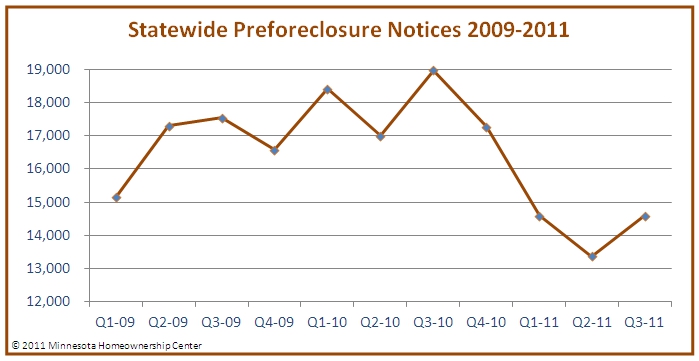
On Thursday, October 27th, the Minnesota Homeownership Center released its third quarter data on the aggregate number of Preforeclosure Notices received by foreclosure counselors in the Homeownership Advisors Network.  The numbers continue to show that Minnesota is slowly emerging from the foreclosure crisis, while also signaling reasons for the state to continue to make fighting foreclosures a priority: the number of preforeclosure notices received in the third quarter of 2011 signals the first uptick in quarterly notices in a year.


In the third quarter of 2011, members of the Homeownership Advisors Network received 14,586 preforeclosure notices, 23% fewer than during the same time period in 2010, but an increase of 9% from the second quarter of 2011, when 13,372 notices were received.


Click To Enlarge


Most troubling is that 85% of the increase in notices from Q2 to Q3 came from the Twin Cities metro… with 43% of the increase coming from Hennepin County alone, which saw an increase of more than 500 preforeclosure notices.  Is this a statistical outlier or the beginning of a troubling trend?  The Minnesota Homeownership Center will continue to track these notices and will report on the Q4 and year-end numbers in early 2012.


The total number of preforeclosure notices received in the state of Minnesota in 2011 now exceeds 42,000:


Click To Enlarge


Here's the breakdown for the number of preforeclosure notices received by members of the Homeownership Advisors Network in the 7-county metro area:


Click To Enlarge


As background for new readers, Minnesota state law (MN Statute 580.021) requires that the foreclosing party provide information regarding foreclosure prevention counseling services to the mortgager (homeowner) and provide the homeowner’s name, address, and most recent known telephone number to an approved foreclosure prevention counseling agency before filing the notice of pendency.


Once the Minnesota Homeownership Center's network of foreclosure counselors receives notification from the lender/servicer/homeowners association, they then contact the homeowner, and track the number of notifications received during the month in their monthly reporting to the Center.


If you or someone you know is struggling with their mortgage payment, new programs, resources and assistance are becoming available all the time. Don’t give up… contact a foreclosure counselor that is a member of the Homeownership Advisors Network today to see if there’s help available for you to avoid foreclosure. Even if you’re not yet behind, now is the time to call. To find your local foreclosure counselor, click here.

Monday, October 24, 2011

HARP Changes - What We Know, What We Don't

It is likely that President Obama will be announcing some major changes to the Home Affordable Refinance Program (HARP) on Monday, October 24th, 2011.  The Federal Housing Finance Agency, the agency that regulates Fannie Mae and Freddie Mac as well as the 12 Federal Home Loan Banks throughout the country, has issued a press release outlining some of the important changes to the HARP program.


What We Know:

  • The goal is to prevent additional foreclosures by allowing additional underwater homeowners to refinance their mortgages at today's low interest rates and/or shortening the term of their mortgage.
  • Most importantly, the current 125% Loan to Value limit (LTV Ceiling) will be removed, but there is still a MINIMUM LTV of 80%.  Borrowers that are underwater by any amount greater than 80% may be able to participate in HARP.
  • Borrowers fees to participate in HARP will be reduced.
  • To participate, borrowers must be current, have not been late on a payment in the last 12 months, and have a verifiable source of income.  Actual affordability ratio (how much income needed) has not been released.
  • The new guidelines should waive the need for a full appraisal if a reliable Automated Valuation Model (AVM) is available on the property.
  • Participation in HARP is a one-time opportunity.  If a homeowner has refinanced under the original HARP guidelines, they will NOT be able to refinance a second time under these new changes.
  • Only mortgages that are owned by the Government Sponsored Enterprises (GSE's), -- Fannie Mae and Freddie Mac -- will be participating in the new program.  The mortgage must have been sold to Fannie Mae or Freddie Mac on or before May 31, 2009.  To determine if your loan is owned by Fannie or Freddie, you can use the following links:


What We Don't Know
This blog post was written on Monday 10/24/2011... and many of the details may change over time.  Please call a non-profit housing counselor for additional details about these HARP changes... or any other question you may have about your mortgage.


  • When will homeowners actually be able to refinance their Freddie Mac- or Fannie Mae-backed mortgage?  Guidelines on the new program will be sent to lenders and servicers by November 15th.  After that, the lenders/servicers will have to convert those guidelines into actual policies and procedures.  This means that it may be mid-December or even early 2012 before a homeowner can actually participate.  In addition, the concept of the program is complicated by the fact that certain servicers DO NOT ORIGINATE loans and may not have the capacity to originate the new HARP loan - without extensive (and time-consuming) changes to their internal systems.  PLUS, as we've seen with the original HARP program, there may be inconsistencies from one servicer to another.
  • What will happen to homeowners in the following circumstances:
    • Multiple mortgages - second lien holders will have to agree to 're-subordinate' their loan to the newly refinanced loan.  While there is no risk to the junior lien holders... we don't know which, if any, second lien holders will agree re-subordinate their mortgages.
    • Private Mortgage Insurance Holders - PMI holders have agreed to make the transfer of insurance from one loan to another easier... the details are still being worked out. 
Once again... as the guidelines to servicers and lenders will not be available until November 15th... it will take several additional weeks for the lenders and servicers to convert those guidelines into policies and procedures, meaning that it may a couple of months before homeowners can access this new phase of HARP.


    Monday, October 3, 2011

    Reminder on Deficiency Judgments


    The Wall Street Journal published an excellent article this weekend on the dangers of deficiency judgments.


    A deficiency judgment is “a judgment lien against a debtor, defendant or borrower whose foreclosure sale did not produce sufficient funds to pay the mortgage in full.”


    In plain English: a homeowner can be sued for the difference between the amount the bank received when they auctioned off the house at the Sheriff’s sale, and the amount of the outstanding mortgages.


    In the Wall Street Journal article, many of the former homeowners had purchased in Florida, where judgment can be sought on ANY mortgage deficiency.  However, Minnesota is a ‘Non-Recourse’ state. This means that FIRST lien holders CANNOT seek judgment (cannot sue) former homeowners for outstanding funds*.


    HOWEVER... any “Junior”, or "Second" lien-holders CAN. If there is more than one mortgage on the property – or if there is a line of credit or HELOC taken out against the property – THOSE lenders CAN sue the former property owner for payment of any outstanding debt.


    Lenders can take up to SIX YEARS in Minnesota to decide whether or not to sue for any deficiency.  In many cases, the lender won't be the ones seeking judgment.  They'll simply sell the outstanding deficiency to collections companies, for pennies on the dollar, who will then be relentless in their efforts to collect.


    One of the scariest quotes from the article comes from a representative of one of the collection agencies:
    "We are waiting for the economy to somewhat heal so that it's a better time to go after people," says Douglas Hannah, managing director of Silverleaf.


    The MN Home Ownership Center has a helpful fact sheet on its website about deficiency judgments. You can download the fact sheet here.


    Deficiency Judgments are just ONE of the MANY considerations struggling homeowners need to think about when facing a possible foreclosure. If you, or someone you know is struggling with mortgage payments... don't wait until it's too late. To find your local non-profit, FREE Foreclosure Counselor, click here. For additional information about preventing foreclosure in Minnesota, click here.


    * There are situations in which a homeowner can open themselves up to deficiency on a first lien.  In a short sale situation, if the negotiations aren't carried out properly homeowners may unwittingly sign paperwork that allows the bank to seek judgement.  This occurs when the bank is willing to release the lien so a short sale can occur, but does not release the underlying debt.  Homeowners that are selling in a short sale situation need to be EXTREMELY careful about the documents they sign before selling.

    Thursday, September 29, 2011

    Two Minnesota Housing Agencies Receive Expansion Grants

    NeighborWorks America invests in expanding services in Minnesota.


    On Friday, September 23, NeighborWorks America announced $3.65 million in grant funding specifically designed for nonprofits to increase their services for underserved communities by expanding the geographic reach of programs that have already been successfully established. 

    NeighborWorks America hopes this grant funding will help agencies with a track record of successful programs bring their initiatives to even more communities in need. Among the 25 organizations receiving grant funds are two Minnesota-based agencies: Southwest Minnesota Housing Partnership and Dayton’s Bluff Neighborhood Housing Services.

    The Southwest Minnesota Housing Partnership works to provide a sufficient supply of adequate, safe, sanitary and affordable dwellings for the people of southwestern Minnesota and is a member of the Center’s Homeownership Advisor’s Network. 

    Dayton’s Bluff Neighborhood Housing Services provides owner-occupied rehab lending and construction management, homeownership education counseling, financial entry assistance, purchase-rehab-resale and new construction. Both of these organizations are making valuable contributions towards enabling successful homeownership for residents of Minnesota. 

    Congratulations to both organizations on receiving a NeighborWorks America grant to continue and expand your good work!

    For more information and a list of all 25 grant recipients, visit the NeighborWorks America news site.


    Wednesday, September 28, 2011

    Foreclosure Counseling - NFMC Report

    Last week, NeighborWorks America released its 6th report to Congress on the National Foreclosure Mitigation Counseling program (NFMC).  The full report is available here.


    Once again, the most recent report shows that while foreclosures continue to impact the nation's housing market, foreclosure intervention/prevention counseling WORKS.


    Here are just a few of the highlights from the report:

    • Homeowners who receive foreclosure prevention counseling are 70% more likely to cure their foreclosure than similar homeowners that don't receive counseling.
    • Counseling clients that received loan modifications were able to reduce their monthly loan payments an additional $260 MORE than homeowners that don't work with a counselor.  The cumulative savings for struggling homeowners?  More than $560 Billion (with a "B") dollars PER YEAR.

    One of the interesting shifts highlighted in the report is the fact that, for the first time, a majority of the clients nationwide that sought foreclosure counseling (53%) hold fixed-rate mortgages with interest rates below 8%.  In October of 2008... only 30% of homeowners were in the same situation.  The foreclosure crisis in the U.S. is definitively no longer just a sub-prime issue.  Over 60% of homeowners cite unemployment or underemployment as the primary reason they are struggling with their mortgage payment.

    All of this information is very similar to the information we've seen in Minnesota.  The Center's 2010 report on the foreclosure prevention counseling is available here.

    Given that foreclosures in Minnesota have once again begun to tick upwards... it is vitally important that homeowners seek the help of a certified non-profit Housing Counseling agency when they're struggling with their mortgage.  Do you know someone that's struggling to make their mortgage payment?  Let them know about free counseling in Minnesota by having them visit: www.hocmn.org for more information.

    Wednesday, September 14, 2011

    Finally - Major Changes in the Mortgage Industry

    Major regulatory changes are shaking up the how servicers deal with delinquent homeowners.


    The number one complaint the Center hears from struggling homeowners is how difficult it is to work with their bank or servicer.  Common complaints include getting lost in overly-complicated voice-mail systems, being routed from one department to another, never being able to speak with the same agent or representative twice, and constantly being told conflicting information when speaking with different agents.  However... a major change is on the horizon that should put an end to all this confusion:


    The Making Home Affordable (MHA) program has updated their servicer guidance to require a “Single Point of Contact for Borrower Assistance”. In essence, the new guidance requires servicers to provide a single relationship manager to each struggling homeowner that is applying for help through the Making Home Affordable program or any other foreclosure-prevention option.  This includes HAMP, HAFA, UP and any in-house modification MHA servicers may provide.


    The relationship manager will be responsible for communicating with the borrower, tracking their documents, responding to inquiries and coordinating the communication with any other bank/servicer employees. Homeowners should receive notice about being assigned to a contact as well as a toll-free number to use and information about the preferred method by which they should send documents to the servicer. The guidelines state that the relationship manager must be a full-time employee of the servicer, not a sub-contractor, who should be fully trained on the MHA program and the other in-house loss mitigation options available to clients.  Even if the client is not eligible for any loss mitigation options, and the loan is foreclosed, the relationship manager must still be available to the homeowner to answer questions about the status of the foreclosure.


    It remains to be seen how well the servicers do implementing these changes, but this is good news for struggling homeowners AND their housing counselors.


    Are you, or someone you know struggling with mortgage payments?  FREE, non-biased housing counselors are available to help!  Don't delay, visit www.hocmn.org to learn more about ways to avoid foreclosure in Minnesota.