Tuesday, July 19, 2011

Court Ruling in Rochester May Affect Foreclosures in Minnesota

When you think of Rochester Minnesota - you may think of the winding Zumbro river, the large IBM site or, of course, the Mayo Clinic.  It's not often you think of Rochester as a setting for courtroom drama that may change the way banks and their attorneys handle foreclosures.  However, a recent court decision in Olmsted County may do just that.


A foreclosure that had taken place in August of 2010 was ruled invalid by Olmsted County District Judge Jodi Williamson, because the Notice of Foreclosure Sale (Sheriff's Sale) was posted in a small newspaper in a neighboring township - not in a publication distributed in the area where the house was located.


The State of Minnesota requires that lenders notify homeowners of a pending sale by attempting to serve the occupant of the property with the Sale Notice (via local Sheriff or process server) AND publish, for 6 consecutive weeks, the date and location of the sale in a local publication.  


According to housing counselors in the Rochester area, many attorneys use the smaller nearby papers due to the costs of publishing foreclosure notices in the Rochester paper.  According to sources, the cost to publish a foreclosure notice in the Rochester Post Bulletin was the highest in the state.  


If this ruling holds, it will mean that some foreclosures that took place in Rochester will be ruled invalid.  


However, this won't be the end of foreclosures in Rochester as:

  1. Many homeowners would have been notified via process server anyway, and
  2. Most lenders will simply refile the foreclosure, obtain a new sale date from the Sheriffs Department and notify homeowners again, this time complying with the state statute.  

It's still great to see that Minnesota is "ahead of the curve" when it comes to consumer protections under the law.  Even when a bank must proceed with a foreclosure - if there are no other options - they must comply with the law.


If you're a homeowner struggling with your mortgage - don't wait for a legal ruling or hope for a legal loophole to avoid facing your foreclosure issue - non-profit (free) housing counseling is available throughout the state - including Olmsted County - to help YOU avoid foreclosure.  Don't delay, visit the Minnesota Home Ownership Center's website HERE to find your local counselor.

Thursday, July 7, 2011

New Video - Emergency Homeowners' Loan Program

The Minnesota Homeownership Center has created a new video to assist consumers in understanding the new Emergency Homeowners' Loan Program.


As yesterday's post mentioned, under EHLP 1,405 selected (unemployed/underemployed) Minnesota homeowners will receive up to $50,000 in interest-free loans over the next two years to help pay mortgage costs. The loans are also 100% forgivable for homeowners who stay in their home for 5 years following the program’s completion.


The program can be a little difficult to understand, as it has very strict qualification guidelines and actually rolls out in several phases over the next few months.  MN Housing and the MN Homeownership Center have created a website: www.EHLPMinnesota.com to try and outline some of the program guidelines and explain to consumers how the program works.


NOW, the Center has added a new video that explains, in seven short minutes, the basics of the EHLP program and how to apply.  


Please feel free to share this video or embed it on your website!  If you do share it, please let us know in the comments or by email: ed@hocmn.org.


Here's the video:


To link to the video from your site, blog or email, use: http://youtu.be/qtQ2NBlxYFE


To embed the video on your site, visit the link above and click on the "Share" button below the video.

Wednesday, July 6, 2011

New Foreclosure Prevention Assistance Program - EHLP

Homeowners facing foreclosure due to involuntary unemployment, underemployment or medical issues are eligible to benefit from a new federal program: the Emergency Homeowners' Loan Program (EHLP).

The program is only accepting applications between July 5 & July 22. Under this program, more than 1,400 selected Minnesota homeowners will receive up to $50,000 in interest-free loans over the next two years to help pay mortgage costs. The loans are also 100% forgivable for homeowners who stay in their home for 5 years following the program's completion.

Homeowners eligible to apply for the federal program must meet several criteria, including:

  • Have faced an income decline of at least 15% due to involuntary unemployment, underemployment or medical issues
  • Have been unable to make their mortgage payment for at least 3 months prior to June 1, 2011
  • Reside in the mortgaged property


Unemployed or underemployed homeowners should visit the program's Minnesota website at www.EHLPMinnesota.com  to learn more about the program, verify eligibility and download a pre-application.

Remember: The deadline to apply for this one-of-a-kind program is 4:30p.m. on Friday, July 22.

Homeowners are also being warned to steer clear of scams.  There is no charge to apply for EHLP and checking eligibility and filling out the pre-application is simple.  An offer to help fill out EHLP forms for a fee or anyone who guarantees that a pre-application will result in acceptance in the program in exchange for money is a scam. 


Visit www.EHLPMinnesota.com for more information.


------------------------------------------------------------------------------------------------------


CALL TO ACTION:  Help Us Spread The Word!

If you know of unemployed/underemployed homeowners who are struggling with mortgage payments, we ask that you spread the word to them about this unique, and short-lived, opportunity.

Below you will find additional tools that you can use to help spread the word (Links to documents):


Maybe a link on your website?  An email to friends/family or clients?  A handout at the cash register or inserted into clients purchases? A blog post on your company or personal blog?  WHATEVER!  We'd love to hear about it!  Post a comment about how you're helping, or visit our Facebook page and share your outreach ideas.  THANKS! 

Tuesday, May 24, 2011

Dodd-Frank Reform Act & QRM Impact on Minnesota

Training for Housing, Lending & Real Estate professionals.

On Tuesday, May 24th, the Minneapolis/St. Paul Business Journal reported that, according the Federal Reserve Bank of Minneapolis, one in three banks in Minnesota are still struggling to recover from the foreclosure/financial crisis.

With this backdrop... Minnesota's mortgage lenders now face the uncertainties created by the implementation of the definition of "Qualified Residential Mortgage" (Section 941) of the Dodd-Frank Reform Act.  This section of the Act will require all financial institutions that securitize mortgage loans to retain at least five percent of the credit risk, and proposes strict definitions for Qualified Residential Mortgages that can be securitized.

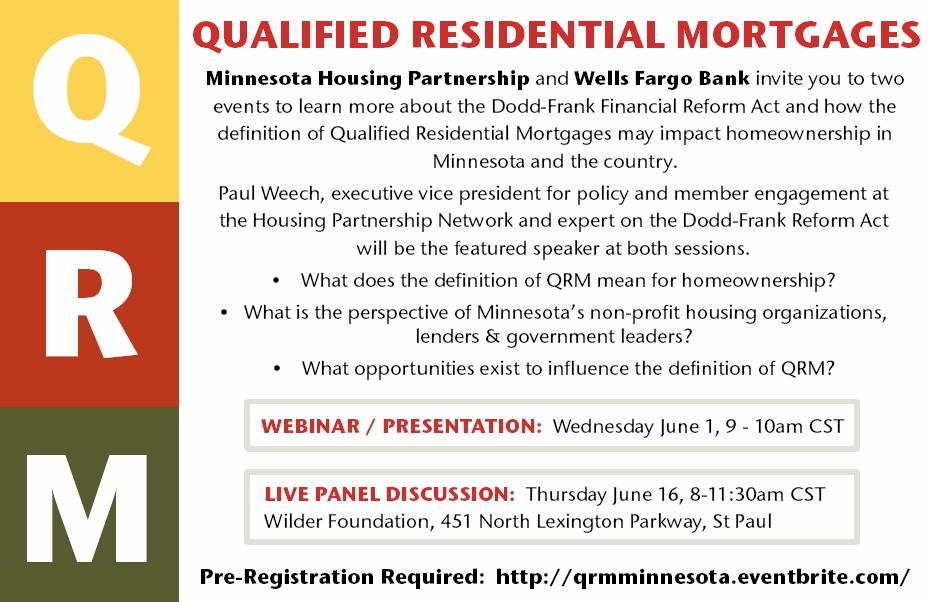
Two of the Minnesota Homeownership Center's partners, Minnesota Housing Partnership and Wells Fargo will be hosting two events offering affordable housing advocates, lending and Real Estate professionals the opportunity to learn more about the Dodd-Frank Financial Reform Act and how the definition of Qualified Residential Mortgages may impact affordable homeownership in Minnesota and the country.

Paul Weech, executive vice president for policy and member engagement at the Housing Partnership Network and expert on the Dodd-Frank Reform Act will be the featured speaker at both sessions.

Participants will learn about:
  • What does the definition of QRM mean for homeownership?
  • What is the perspective of Minnesota’s non-profit housing organizations, lenders & government leaders of QRM?
  • What opportunities exist to influence the final definition of QRM?

SESSION 1: Webinar
Date & Time: Wednesday, June 1st, 9-10am CST

SESSION 2: Live Panel Discussion
Date & Time: Thursday, June 16th, 8 - 11:30am CST
Location: Wilder Foundation, St. Paul, MN

To register (pre-registration required) or to learn more about the topics covered, visit the registration page here: http://qrmminnesota.eventbrite.com/

Friday, May 20, 2011

New Mortgage Disclosure Forms

Share your opinion with the Consumer Financial Protection Bureau


It’s not very often that the general public gets to weigh in on items that will affect the entire mortgage industry. Recently, the Consumer Financial Protection Bureau (CFPB) released drafts of a new one-page (two-sided) mortgage disclosure form and is asking for YOUR opinion. The final form will combine the two mortgage disclosures that are currently required -- the federal Truth in Lending Act (TILA) mortgage disclosure and the Real Estate Settlement Procedures Act (RESPA) Good Faith Estimate -- into one two-page form, down from the current five pages.

While these forms are covered in-depth in the Home Stretch workshop, they certainly can be confusing for the average homebuyer, and the CFPB is asking the general public to offer their opinion on which of the two is easier for you (or your customers) to understand.

Both versions show the key loan terms like the interest rate, the monthly loan payment, any closing costs and taxes. Borrowers can quickly see how much they'll be paying per month, and, if the loan is adjustable, how those payments might change throughout the life of the loan.

Interestingly, the form also shows the Annual Percentage Rate (APR) paid over a five-year period, along with the amount of principal you will have paid off in five years (real equity).

The CFPB will be working on these forms until July of 2012, but over the next few months, the agency will be revising and re-uploading the form(s) on its site based on the input it receives.

So… go vote! Let your opinion be heard. Then come back and let us know which one you prefer in the comments. The two forms are available here.

When comparing the forms, we recommend that you focus on what information mortgage lenders and/or brokers should share with homebuyers to make the process as easily understood and transparent as possible. Remember… our goal at the Minnesota Home Ownership Center, and of our lender and real estate partners, is successful homeownership. Which form do you think will best help potential buyers in that respect?

Are you a Minnesota resident thinking of buying your first home? Do terms like TILA, RESPA and GFE sound like a foreign language? You can learn more about these, and many more, terms, the mortgage loan process and the best steps to follow to be a successful homeowner by taking a Home Stretch workshop. For more information, click here.

Thursday, May 19, 2011

Single Point of Contact A Reality!

Servicers must assign a "Relationship Manager" to every struggling borrower

Some exciting news was released by the administration of the Making Home Affordable program yesterday (US Treasury and Fannie Mae).  By no later than September 1st, every struggling homeowner that applies for a loan modification under Making Home Affordable must be assigned a single point of contact - who must be an employee of the servicer with a direct, toll-free telephone number - for homeowners to be able to communicate with about their documents, their application and answer questions.  This same point of contact, known as a Relationship Manager, will also be available for non-profit counselors to use when speaking with the servicer about a homeowner's situation. 

Servicers have until November 1st to assign a Relationship Manager to EXISTING MHA Consumers.  (Homeowners that are already in review or in a trial modification).

If implemented correctly... this should end a huge number of the complaints the Center hears from homeowners that are struggling with their mortgage:  "I can never speak to the same person twice,"  "They lose my paperwork,"  "I've had to send in the same document 3 or 4 times"... etc. 

According to the Supplemental Directive 11-04 for Servicers, released on May 18th:

The same relationship manager is responsible for managing the borrower relationship throughout the entire delinquency or imminent default resolution process, including any home retention and non-foreclosure liquidation options, and, if the loan is subsequently referred to foreclosure, must be available to respond to borrower inquiries regarding the status of the foreclosure.

For now, the Supplemental Directive will only be in effect for servicers that are participating in the Making Home Affordable initiative, and have a Program Participation Cap of more than $75mm.  Basically, this covers the largest 20 servicers in the country... and hopefully smaller servicers will follow suit.  Both GSEs (Fannie Mae and Freddie Mac) are currently exempt from this directive.  In Minnesota, given the partnership between Fannie Mae, the Minnesota Home Ownership Center and the Homeownership Advisors Network, there is already a single point of contact through the local non-profit counseling agency.

Will this improve the MHA program?  What other improvements do you think are necessary... leave us a comment and let us know what you think!

Monday, May 16, 2011

Preforeclosure Notices Drop 21% in First Quarter

The beginning of the end of the foreclosure crisis in Minnesota?


Source: revjavadude
The Minnesota Homeownership Center has released its most recent report on the aggregate number of Preforeclosure Notices received by foreclosure counselors in the Homeownership Advisors Network and the numbers signal a possible light at the end of the tunnel for the foreclosure crisis that has affected the housing industry and Minnesota families for more than four years.

In the first quarter of 2011, members of the Homeownership Advisors Network received 14,595 preforeclosure notices, a drop of 21% from the same time period a year ago, and a 15% drop in the number of notices received last quarter (Q4, 2010).

This number reflects the lowest number received by counseling agencies since we started compiling the data in the first quarter of 2009:


Click To Enlarge


The drop in notices received by counseling organizations in the Twin Cities metro was equally dramatic. 8,836 notices were received, a 20% decrease over the same time period in 2010, and, like what we saw statewide, a 15% drop in the number of notices received last quarter:


It’s certainly too early to celebrate, as the number still means that almost 15,000 Minnesota families are still dangerously close to losing their homes to foreclosure and thousands of others are still struggling with their monthly mortgage payment. In addition, the most recent (Q1) Sheriff Sale numbers from HousingLink while down, still reflect numbers that are 400% higher than pre-crisis numbers. But it might be time to be cautiously optimistic that the very worst of the crisis is over. Remember, the housing crisis was a overwhelming painful for Minnesota and families involved and recovery will take MANY years.


If you or someone you know is struggling with their mortgage payment, new programs, resources and assistance are becoming available all the time. DON’T GIVE UP… contact a foreclosure counselor that is a member of the Homeownership Advisors Network TODAY to see if there’s help available for YOU to avoid foreclosure. Even if you’re not yet behind, now is the time to call. To find your local foreclosure counselor, click here.

For additional information about the statutory requirement for pre-foreclosure notices, visit the Office of Revisor of Statutes website here.

Thursday, May 12, 2011

Foreclosure Moratorium in Minnesota?

Disaster Areas in Minnesota Affected


On Tuesday May 11th, the Federal Government announced that federal disaster aid had been made available to Minnesota to assist with the state and local recovery areas from the spring storms and flooding that started back in mid-March and continues through today. While this means that Federal funding is available to state and local governments to help with protection and recovery efforts, there is also a housing-related issue that this National Disaster declaration puts into place: a 90 day moratorium on any foreclosure action on any FHA backed loans for consumers affected by the storms/flooding. (Fannie Mae and Freddie Mac and a handful of private lenders/servicers also have standing policies about halting foreclosures in Disaster Areas.)

The counties affected by the National Disaster declaration are: Big Stone, Blue Earth, Brown, Carver, Chippewa, Clay, Grant, Lac qui Parle, Le Sueur, Lyon, McLeod, Nicollet, Redwood, Renville, Scott, Sibley, Stevens, Traverse, Wilkin, and Yellow Medicine counties.

Remember, the moratorium and other tools that HUD has put in place for lenders (mortgagees) to use are only available to homeowners that have been DIRECTLY affected by the disaster.

In a clarification conversation the MN Home Ownership Center had with local HUD representatives in Minnesota, the word AFFECTED can mean:

  • Either the property itself was damaged or destroyed by the storms/flooding,
or

  • The homeowner’s income was affected by the flooding (their place of work or business is flooded, for example)

Affected homeowners who have an FHA-backed mortgage are instructed to call their lender to see what tools FHA has in place for helping with foreclosure avoidance following the disaster declaration.

In addition, the Homeownership Advisors Network is ready to assist ANY homeowner that is struggling with mortgage payments, especially those homeowners that have been affected by the spring storms.

Don’t delay, contact a foreclosure counselor that is a member of the Homeownership Advisors Network TODAY to see if there’s help available for YOU to avoid foreclosure. Even if you’re not yet behind, now is the time to call. To find your local foreclosure counselor, click here.

Wednesday, May 4, 2011

Dangerously Unprepared

Buying a home without Home Stretch


Even after all of the news about the dangers associated with purchasing a home without being fully prepared, it appears as though the message still isn’t getting out to potential homebuyers. According to a newly-released survey from Zillow Mortgage Marketplace, a surprisingly high number of people don't understand the home buying process, especially the information about obtaining a mortgage, and may be making poor financial decisions as a result.

Those surveyed answered basic questions about mortgage information and terminology wrong almost half of the time. Forty-four percent of buyers admitted that they are not confident in their knowledge of mortgages or the mortgage process!


Other findings include:


  • About 77% of prospective homebuyers did not clearly understand what factors are involved in determining a mortgage interest rate, believing that annual income is an important determinant.
  • More than one-third (34%) of the respondents did not understand that lender fees are negotiable and that they vary by lender. They believe lenders are required by law to charge the same fees for credit reports and appraisals.
  • More than one-third (37%) of prospective home buyers who were polled believe that pre-qualifying for a loan means they have secured financing. The reality is that "pre-qualification" is used to describe an earlier step in the process when a lender or Homeownership Advisor approximates how much you can afford, but does not pull your full credit report or request any sort of documentation to verify the information you provide. A pre-qualification is NOT a pre-approval.

Before you start the process of making what may be the LARGEST PURCHASE IN YOUR LIFE, we highly recommend that you participate in a Home Stretch workshop. This is a class for potential homebuyers that is recognized nationally as a proven tool for preparing Minnesotans to be successful homeowners. There is an entire section of the Home Stretch workshop dedicated to fully understanding mortgage loan terminology, how to shop for a loan, how credit affects loan payments and how to avoid being taken advantage of when choosing a loan.

Year after year, Home Stretch participants report that help with understanding mortgages and the loan process was the MOST HELPFUL part of the workshop. In fact, NINETY-FIVE PERCENT of Home Stretch participants report that their participation in Home Stretch will help in the process of buying a home, and 98% would recommend the workshop to someone else. (For more information about consumer satisfaction with Home Stretch, view the most recent report here).


Are you thinking of purchasing a home in Minnesota? You can learn more about the mortgage loan process - - and the entire home buying process by taking a Home Stretch workshop. For more information, click here.

Monday, May 2, 2011

HECAT Request For Proposals Available

As many of our readers know, the State of Minnesota is unique in that we are the only state in the country with a dedicated pool of funds that provides financial support to eligible non-profit organizations to deliver a variety of homebuyer/homeowner education, counseling and training services to Minnesotans. This dedicated pool is known as HECAT (The Homeownership Education, Counseling and Training Fund).

Some of the valuable services that are funded through HECAT include:
  • Pre-purchase education and counseling (Home Stretch),
  • Post-purchase education and counseling,
  • Home equity conversion counseling (Reverse Mortgages) and
  • Foreclosure prevention counseling
Funds for HECAT come from a public-private partnership of four agencies and organizations that are fully invested in ensuring that Minnesotans have access to the education and counseling tools necessary to achieve successful (sustainable) home ownership:


Each of the four funding partners not only contribute financial resources they also actively participate in the grant-making process and provide technical assistance throughout the year.

The Request for Proposal (RFP) for funding for programs in 2011 and 2012 (funding year runs from October 1st through September 30th) is NOW OPEN.  The deadline for applications is 5:00pm on Wednesday, June 1st.  This is a STRICT deadline.

For more information about HECAT, or to view the RFP and even lists of award recipients from previous years, visit the Minnesota Housing website... here.

Wednesday, April 27, 2011

Partnership With Fannie Mae Launches In Minnesota

There's an expression in Spanish that's usually used when describing politicians:  "Los mismos perros, distintos collares"  (Same dogs, different collars).  Many homeowners struggling with mortgage payments have felt the same way about program announcements and offers of help they've heard during the housing crisis.  "It may get headlines... but can it really get me help?"

Today, the Minnesota Home Ownership and Fannie Mae announce a partnership that really is a game-changer.  This new partnership will accelerate the response time for struggling Minnesota families with loans that are owned by Fannie Mae.

Homeowners that are struggling with mortgage payments will meet with experienced foreclosure prevention counselors throughout the state that are members of the Homeownership Advisors Network to discuss their mortgage situation and determine options to avoid foreclosure. These counselors in turn will work directly with dedicated LOCAL Fannie Mae staff to find sustainable and affordable solutions for Minnesota’s homeowners.


As always... this assistance is FREE.

One of the unique aspects of this partnership has been the creation of a standardized document collection process for ALL possible loss mitigation options. Streamlining the documentation process reduces homeowner frustration and improves response times from servicers.  No longer will homeowners have to submit (and re-submit, and re-re-submit) different versions of the same documents.  This all happens ONCE - on the front end and with the assistance of a Foreclosure Counselor, and is then submitted electronically to Fannie Mae staff right here in Minnesota.  Fannie Mae staff then leverage their relationships with lenders and servicers (as the investor) to find long-term solutions.

The Center knows that one of the greatest advantages to working with a certified non-profit Housing Counseling is that homeowners  are more successful when they have access to information and the tools necessary to get a quick response to their mortgage situation.  This new partnership takes this advantage to a whole new level.

The services offered through this new partnership are only for borrowers who have a mortgage held by Fannie Mae. Homeowners can determine if Fannie Mae owns their loan by visiting www.fanniemae.com/loanlookup or by contacting Fannie Mae (Toll-Free) at 1-800-7FANNIE. Homeowners who do not have loans owned by Fannie Mae are still encouraged to contact a member of the Homeownership Advisors Network to learn more about their individual options to avoid foreclosure or to learn more about the foreclosure process by visiting www.hocmn.org or calling us at 866-462-6466.

Plus:  the Center will be launching this exciting new partnership with the assistance of Fox-9 news!  Julie Gugin from the Center, and Jeff Hayward, Sr. VP from Fannie Mae, will be on the Fox-9 Morning Show from 7-9am on the Wednesday the 27th.  Other Center staff will also be featured on both the 5:00 and 9:00pm newscasts.  (Check us out after American Idol!)  We'll update this post with links to videos as soon as they are online.

UDPATE:  Here's the piece from this morning's Fox-9 news:


(If the embedded video doesn't work... click here to view on the Fox-9 Website.

Wednesday, April 20, 2011

Successful homeownership - There is a path

Even though it might still be snowing, it really is spring in Minnesota and the only thing that appears faster than our potholes is the number of "For Sale" signs that pop up in front of homes across the state.

Thanks to our prolonged foreclosure issues... both prices and interest rates are low.  Homeownership is more affordable now that at any other time in recent memory, and many people are thinking about becoming homeowners.  Venturing into the world of home ownership can be VERY exciting! However, it can also bring some unwelcome surprises if you're not fully prepared.

Now, the Minnesota Home Ownership Center has prepared a new online tool that helps outline the path to successful homeownership.

Give it a try here, and let us know what you think in the comments!

If you're thinking about buying your first home in Minnesota... make sure you're on the right path - the path to successful home ownership.  There is tons of helpful information on the Center's website about buying your first home including information about affordable mortgages, down payment assistance and finding someone to help you through the process.  For more information, visit our website, here.

If you're not sure what YOUR path to successful homeownership should be... or would like to speak to a FREE non-profit Housing Advisor (Housing Counselor) about YOUR next steps... visit the Center's website to connect with the agency closest to you that offers these services.

Tuesday, April 12, 2011

6 Days Left To Pay Your Taxes

2010 Taxes Are Due on April 18th


So… why are we talking about taxes on a HOUSING blog? It’s not just a simple reminder to pay your taxes - it’s a reminder that if you took advantage of the (up to) $7,500 “tax credit” on a home purchased between April 9th 2008 and July 1st 2009, your first repayment of that “tax credit” is due on your 2010 return.

Here’s a link to our original fact sheet (created in 2008, no longer available on our website).

Here’s the important text:
Homeowners will have to pay it back. While these funds have been labeled a tax credit, it's really a 15 year, zero interest loan that must be paid back in equal installments over 15 years, starting in the second year after the home is purchased. If you buy a house this year and claim a $7,500 credit on your 2008 tax return, you'll have to pay an additional $500 a year in taxes for 15 years, starting in 2010.


Time to start paying the piper.

The SECOND tax credit, which was a maximum of $8,000 for first-time buyers who purchased between January 1st, 2009 and April 30th, 2010 (last year’s tax credit) does NOT have to be paid back via your tax returns, unless you:
  1. Sell the home within three years of purchase or the home is no longer your primary residence.
  2. If you sell within three years, and the amount you make on the sale is less than the tax credit, you only have to repay up to the amount of the gain… not the full amount.
  3. If you make MORE on the sale, or the home is no longer your primary residence, then you do owe the entire amount.
Confused? Many people are… so make sure you speak with a qualified tax professional if you have any questions about the Homebuyer Tax Credit(s) or any amounts you may owe.

Monday, April 11, 2011

Help With Foreclosure Postponement

New online tool can help homeowners with foreclosure postponement


Minnesota is one of the only states in the country where struggling homeowners have the ability to legally postpone their foreclosure sale (Sheriff's Sale).  Minnesota state law has allowed homeowners the right to delay their foreclosure sale on their home by five months (11 months in certain rural/agricultural areas) since mid-2009. 

However, knowing the steps to take and how to fill out the legal documents necessary to postpone the sale has been an obstacle for many Minnesota homeowners.  That changes today with the announcement that the Minnesota Legal Services Coalition, Southern Minnesota Regional Legal Services and the Minnesota Home Ownership Center have partnered on the creation of a free online tool that assists homeowners with the process.

How does it work?
The Foreclosure Postponement Tool, here, asks homeowners a series of simple questions, then automatically fills out the legal form they need, known as the "Foreclosure Sale Postponement Affidavit." Along with their finished form, users also receive a set of simple, yet detailed instructions on how to file the form properly. Once the form has been filed and the proper parties have been notified, the postponement takes effect.  If you choose not to set up a username, the system will NOT save any personally identifying information... so you can be assured of confidentiality.

Should I postpone?
Before deciding to delay or postpone a Foreclosure Sale, homeowners should consult with a non-profit housing counselor that specializes in foreclosure prevention to understand the pros and cons of a postponement.  To find your local foreclosure counselor, click here.


Make the Most of the Extra Time
After you've submitted the necessary documentation, and your sale has been postponed, what happens next?


Homeowners should start by finding a free, non-profit foreclosure counselor - while always staying wary of scams. Some web sites offer to "save your home" by charging premium prices for services that are available for free.  To mitigate this problem, the Foreclosure Postponement Tool encourages users to contact the Minnesota Home Ownership Center. The Center offers referrals to reputable non-profit counselors via the Homeownership Advisors Network.


Try it out!  www.LawHelpMN.org/ForeclosurePostponement

Thursday, April 7, 2011

Foreclosure Scams Are Still An Issue

BE CAREFUL OUT THERE!

On April 6, 2011, a coalition of fair housing non-profit organizations released their findings of a year-long undercover investigation of 80 "loan modification" (foreclosure rescue) companies, which reveals that the industry is rife with unethical, corrupt and even illegal practices.  These practices include over-promising & under-delivering, charging fees for services that are available free from nonprofit organizations and even advising clients on how to commit acts of fraud against their lenders.

The report - which has a GREAT title: “Have I Got a Deal for You! An Undercover Investigation of Mortgage Loan Modification Scams,” was released by The National Fair Housing Alliance, the Connecticut Fair Housing Center, Housing Opportunities Made Equal of Virginia, Inc., and the Miami Valley Fair Housing Center.  It documents some of the tactics mortgage modification scammers use to take money from struggling homeowners.

Here are just a few of the results of the report: 
  • 55% of the scammers required an upfront fee to start work or required a low initial fee to conduct minimal work on behalf of distressed homeowners, such as reviewing loan documents;
  • 43% guaranteed or promised they could secure a loan modification even before learning about the homeowners’ financial limitations;
  • 24% advised or encouraged homeowners to stop making their mortgage payments or to stop contacting their lenders;
  • 16% guaranteed a new, much lower interest rate ranging between two and 6 percent on modified loans;
  • 12% discouraged homeowners from seeking free help from government-approved housing counseling agencies;
  • 8% encouraged homeowners to provide fraudulent information to their lenders.
The full report is available here.

None of these findings surprise us here at the MN Home Ownership Center.  We hear from homeowners repeatedly that have spent money, lost time and been taken advantage of by less-than-scrupulous mortgage "rescue" operations.  If you are struggling with your mortgage, THERE'S NO NEED TO PAY FOR HELP.  There is a network of FREE, non-biased housing counseling agencies that can assist.  To find your local non-profit foreclosure prevention counselor, click here.

For more information on what's being done in Minnesota to fight foreclosure rescue scams, visit the Center's "Look Before You Leap" website.  You can help us fight these scammers in Minnesota!

Wednesday, March 30, 2011

Buying a Home With Someone?

One of the best reasons to take a Home Stretch workshop is to be able to fully understand all of the terminology that is related to homeownership.  This is especially important when closing on a property that you are buying with someone else... as a couple, family or just friends purchasing a property together.

In Minnesota when two or more people buy a home together they can choose joint tenancy or tenancy-in-common. The Minneosta Home Ownership Center has created a new Fact Sheet to provide an overview of both types of ownership.

Here's how it works:


Joint Tenancy
Joint tenancy is when two or more people own equal shares of a home. If an owner dies, ownership is transferred to the remaining owner(s).This is called the “right of survivorship.”


Tenancy-in-Common
Tenancy–in-common is when two or more people own a home. Ownership does not have to be equal. If an owner dies, ownership is transferred to the person(s) named in their will.

Tenancy-in-Common Agreement


When choosing tenants-in-common, a tenancy-in-common agreement is recommended. Agreements are usually written with the assistance of a real estate attorney.


The agreement generally includes:
  • The agreed to percentage of ownership for each owner.
  • A formula to determine the amount of each owner’s payment.
  • Consequences for an owner not paying their portion of the mortgage.
  • How property maintenance and the cost will be shared.
  • Restricting the sale or transfer of ownership without the consent of the other owner(s).
  • Acceptable reasons and the price to buyout an owner.
  • What happens if an owner declares bankruptcy or in the event of a death.

To view this new fact sheet, and other helpful information for first-time buyers, visit the Center's website here.

If you're thinking of purchasing your first home... and would like to learn more about the types of homeownership and lots of other important information, you should take a Home Stretch workshop! 

Thursday, March 24, 2011

More Warnings Against Scams

The Huffington post has a great story up about the dangers that struggling homeowners face when they don't know where to turn for help, or when they grow frustrated trying to work with their lender: they become prey to scam artists.

The piece is here.

The Minnesota Home Ownership Center has additional information on avoiding scams on the "Look Before You Leap" (Avoiding Foreclosure Scams) website, here.

Here are some additional tips on how to avoid foreclosure rescue scams:
  • Don't fall for the lies that the scammers use to lure in homeowners: claims that they can save your credit, promise to find a buyer for your property or offers of free rent or gifts.
  • Don't EVER be pressured to sign a contract... especially if you don't understand something.  If something sounds too good to be true, it probably is.  Speak with an attorney or a certified foreclosure prevention specialist who can help review documents with you.
  • Don't EVER send your monthly mortgage payment to a third party or a mortgage 'rescue' company, even if they promise to forward those payments on, or hold them in a special account.
  • Don't rely on verbal agreements.  Get everything in writing and keep copies of all documents, ESPECIALLY the ones you sign.  This is good advise, but many of the homeowners highlighted in the HuffPo article had 'contracts' and those contracts were worth less than the paper they were printed on, so be very careful.
  • Don't sign any form or contract with blank spaces or blank lines. 

Basically, we can sum up these scams in one line: no one that is struggling to pay their mortgage should have to pay to get help!

There is a network of FREE foreclosure prevention counselors available in Minnesota that are ready, willing and able to sit down with you to discuss your options for avoiding foreclosure.  To connect with a foreclosure prevention counselor, click here.  To learn more about the options available to Minnesota residents to avoid foreclosure, click here.

Tuesday, March 15, 2011

Housing Indicator - 2x4 Report

The Minnesota Housing Partnership has recently released its updated report (known as the "2 x 4 Report") that studies two indicators for each of four key housing areas:

  • the home ownership market,
  • the rental market,
  • homelessness, and
  • the housing industry.

The report is a great resource for housing information, and is designed to provide a concise, easy-to-digest, graphic overview of the state of housing in the state of Minnesota.

The complete report is available here.

Focusing on the "Owners' Market" segment of their report, it's interesting to see that delinquencies fell slightly to 6.5% in the fourth quarter of 2010, continuing the downward trend that we've seen throughout the year.

Somehow... there is a disconnect happening that isn't easily explained:

In both 2008 and 2010 delinquencies were LOWER than 2009, but actual foreclosures (Sheriff's Sales) were higher in both 2008 and 2010.  In reality, the delinquency rate maxed out at just over 8% in Q4 2009, but the highest quarters for sheriff's sales have been Q2-2008 and Q3-2010.

View the report... and add your 2-Cents in the comments. 

Tuesday, March 8, 2011

Home Repair & Rehab Resources in Minnesota

The Minnesota Home Ownership has created an easy-to-use resource listing affordable home repair and rehab assistance programs throughout the state of Minnesota. Programs included in the resource include:
  • emergency repair,
  • energy efficiency upgrades,
  • lead hazard abatement, and
  • general repair.

Some funds are direct grants to homeowners and others are loans, usually with below market interest rates or forgivable terms. The resource outlines dozens of programs available throughout the state and includes information on who to contact and how to apply.
 
Here's a sample of one of the Rehab loans (Zero interest, deferred for 20 years) available to residents of St. Louis, Lake and Cook Counties.  There are several dozen other programs outlined in the printable resource:
 
 
Click To Enlarge
 
The complete “Home Rehab and Repair Matrix” can be viewed and downloaded, free of charge, from the Minnesota Home Ownership Center’s website here.


Monday, March 7, 2011

New Research on Foreclosures from Minnesota Housing


Minnesota Housing, the State of Minnesota's Housing Finance Agency, has released its "Residential Foreclosures in Minnesota, Winter 2011" report.  The data, on the delinquencies and foreclosures of residential mortgages in Minnesota, comes from LPS Applied Analytics.

The report provides information about key statewide trends on both delinquencies and foreclosures, and shows, using full-color maps, the foreclosure and delinquency hotspots around the state as well as information about changes in the number of delinquent and foreclosed loans in each zip code.

In addition, the appendices include two large tables that provide data for each residential zip code in the state... a plethora of information to dig through!

Here are some of their findings:
  • The state’s delinquency rate for residential mortgages has increased significantly over the last several years. Between the fourth quarter of 2005 and the fourth quarter of 2009, the percentage of mortgages that were at least 60 days past due quadrupled from 1.10% to 4.71%.1 On the positive side, the delinquency rate declined during all four quarters of 2010. By the fourth quarter of 2010, the rate was down to 3.43%, which is still very high by historical standards.
  • North Minneapolis and East St. Paul, like most areas of the state, experienced a decline in the number of loans at least 60 days past due.
  • The biggest increases in post-sale/REO loans were concentrated in the outer ring of the metro area and counties further out, including Rice, Le Sueur, Sibley, McLeod, Renville, Meeker, Benton, Kanabec, and Pine.

The full report is available here.

Thursday, March 3, 2011

Fannie Mae's 2010 National Housing Survey

Fannie Mae has released the findings of their latest National Housing Survey that polled homeowners and renters between October and December, 2010.

The Survey has some interesting facts and figures to digest:  
  • 65% of Americans believe that it’s a good time to buy a home. This is almost unchanged from last January, but down five points (from 70%) that thought it was a good time to buy in June (2010).
  • Just like last year… A large majority (78%) believe home prices have either bottomed or will rise over the next year. However, there have been price declines in most major markets throughout the U.S. over the past year (including here in Minnesota), meaning 78% of people polled in 2010 were wrong.
  • The percentage of those polled who believe buying a home is a safe investment has fallen six points to just 64 percent since last January’s report.

The Center believes that potential homebuyers should ALWAYS be cautious when buying their first home – and be VERY careful when hearing things like “Now is a good time to buy!” and “Housing is a safe investment!”… the “Crowd” may not aways be right.


When renters were asked why they wouldn’t purchase a home… their responses are revealing:

  • The #1 reason cited, by almost half of the respondents, was that they believe their credit was not good enough to obtain a mortgage.
  • In addition, the #2 reason, cited by 47% (multiple answers were allowed)… was that they don’t think they can afford both a mortgage and the upkeep of a home.

While the Center applauds renters that approach the idea of homeownership cautiously… there is a way to KNOW if your credit is good enough… and KNOW exactly how much you can afford to purchase – or if purchasing a home is even a good fit for you: We recommend you take a homebuyer workshop! In Minnesota, the state's premier homebuyer (pre-purchase) education curriculum is known as Home Stretch. To learn more about Home Stretch, and other services for homebuyers, visit the Center's website here.

For more information about the National Housing Survey and to see the complete report, visit Fannie Mae's website, here.