Showing posts with label Home Stretch. Show all posts

Monday, August 26, 2013

Home Stretch: An “Insider’s” Perspective

This post is a guest post by Laura Grevas, Program Coordinator for the Minnesota Homeownership Center.

_______________________________


Before I began working at the Minnesota Homeownership Center, I knew as much about the home buying process as your average twenty-something.

In other words, I didn't know much.

I knew that affordable homeownership is the cornerstone of thriving neighborhoods. I didn't know just how much I didn't know about buying a home. That’s why homebuyer education is so important. Buying a home is likely the largest purchase any of us will make in our lifetimes, so it pays to be prepared and have at least enough information to advocate for your family’s best interest.

Because the Center oversees a network of agencies that provide Home Stretch (homebuyer education) Workshops across the state, new employees are asked to join a class to get a sense of our flagship program.
The folks at Community Neighborhood Housing Service – one of more than 30 Home Stretch providers– were kind enough to let me sit in on a portion of their Saturday class in St. Paul.

Our facilitator began the afternoon session by talking about real estate basics, before introducing a local Realtor who schooled us in how and why people buy – or want to buy- where they do. Realtors aren't ethically allowed to steer their clients away from or toward certain neighborhoods, which is something I didn't know. The workshop format allows plenty of time to ask questions, both of the facilitator and the guest speakers, experts in their field who volunteer their time to teach new homebuyers. My classmates (the ones who were actually, you know, buying a house) swapped stories about their experiences so far, and I think we all learned something new.

My favorite guest speaker was the professional home inspector. With more than 20 years of experience, this inspector had seen some pretty major problems in folks’ prospective dwellings. In addition to teaching us how to find a reliable inspector and make the most of the inspection process, he shared some little-known home safety tips.

The average age of homeownership in Minnesota is 29, so we’ll see if that happens for me. Either way, I’m glad I observed this class – it definitely provides lots of valuable information that could prevent headaches down the road! 

Tuesday, June 18, 2013

Celebrate Homeownership Month With Us!

The Minnesota Homeownership Center and the Homeownership Advisors Network are partnering with Minnesota Housing, MN Association of Realtors®, USDA Rural Development and the Minnesota Department of Commerce to promote homeownership and stabilize Minnesota’s neighborhoods by sponsoring homebuyer education in June.

In celebration of Homeownership Month in June, the Center is pleased to announce the availability of free homebuyer education.   This opportunity is available thanks to the generous support of several public and industry partners.

Quality homebuyer education is the foundation of successful homeownership and is key to stabilizing Minnesota’s neighborhoods.  A recent study conducted by Neil Mayer & Associates and the credit bureau Experian found that homeowners that receive pre-purchase education and counseling services are 30% less likely to become seriously delinquent on their mortgage in the first two years after closing.

In Minnesota, homebuyer education is available online and in-person.  Both courses include an in-depth understanding of the homebuying process, how to choose the right home, the importance of credit and good financial management, how a lender determines how much to lend, the importance of working with a real estate professional and the buyer’s rights and responsibilities once they become an owner.

Free in-person Home Stretch Workshops are available at participating locations throughout the state from June 22-29.

Framework, the most comprehensive online homebuyer education course available, will also be free to the first 100 customers who sign-up and use the special coupon code: MNPROMO13 

Friday, May 24, 2013

Immigration Reform: A Boost for Housing?

Recent data shows that the housing market continues to improve here in Minnesota and in many markets throughout the country.  The recovery may get an additional boost if the forecasts of the National Association of Hispanic Real Estate Professionals (NAHREP) hold true.  

On May 20th, NAHREP released a report that projects over $500 Billion dollars in spending related to real estate and homeownership spending if Washington passes comprehensive immigration reform for the more than 11 million undocumented immigrants currently living in the US.  

They forecast that up to 3 million of these immigrants could become homebuyers over the next several years with an average home price of about $173,000. 

Their reasoning is simple: the options for accessing mortgage loans and lending products for undocumented immigrants are extremely limited.   Any legalization of their immigration status would immediately allow these potential buyers to obtain a Social Security number, a requirement for most lending products.  

NAHREP’s projections maybe overstated (it’s impossible to gauge the future intentions of those who are currently out of status in the US) and immigration reform is far from a done-deal in Washington, but the Minnesota Homeownership Center understands the potential boost for housing that legalization would bring.   A recent report from the University of Southern California found that over one third of the increased demand for homes in this decade has been generated by immigrant buyers. 

The Minnesota Homeownership Center is prepared for a possible influx of new first-time homebuyers:

  • Our website contains important information for potential homebuyers and easily allows users to switch quickly between Spanish and English;
  • We continue to provide support for Home Stretch workshops (and supplemental materials) in Spanish throughout the State;
  • Our online homebuyer education tool, Framework, will be available in Spanish in the coming months;
  • We continue to support and administer the Emerging Markets Homeownership Initiative that brings together industry professionals and non-profit organizations working to improve homeownership rates in communities of color.

First-time buyers, citizens and immigrants alike, are reminded that before you start the process of making what may be the LARGEST PURCHASE IN YOUR LIFE, we highly recommend that you participate in a Home Stretch workshop or take the online homebuyer course, Framework. These classes are recognized nationally as a proven tool for preparing Minnesotans to be successful homeowners.  These workshops help you to understand, start to finish, the process of becoming a successful homeowner and cover important topics like:

  • real estate and mortgage loan terminology, 
  • how to shop for a home and a loan that are right for YOU, 
  • how your credit affects your loan payments, 
  • how to avoid being taken advantage of during the homebuying process, 
  • and much, much more. 

For more information about upcoming Home Stretch workshops, click here.  To take Framework online, click here.

Wednesday, March 20, 2013

Foreclosure Prevention Starts Before the Mortgage Is Even Signed


Homebuyer education dramatically decreases probability of delinquency 

New research from NeighborWorks America conducted by Neil Mayer & Associates and the credit bureau Experian finds that homeowners that receive pre-purchase education and counseling services, like those offered by the Homeownership Advisors Network in Minnesota, are 30% less likely to become seriously delinquent on their mortgage in the first two years after closing.

The study looked at over 75,000 mortgages originated between 2007 and 2009 to see the effect pre-purchase education and counseling services had on the probability of a loan becoming seriously delinquent in the first 24 months:


The research shows that the investment the Minnesota Homeownership Center has made in homebuyer services over the last 20 years helped lessen the effects of the foreclosure crisis on Minnesota.

In the last ten years alone, almost 50,000 households have graduated from Home Stretch.  Thanks to the knowledge they received in Home Stretch, hundreds of homeowners avoided falling seriously delinquent on their mortgage.  For more information on Home Stretch, check out our most recent Homebuyer Services report, here.

NOW... Minnesota homebuyers have the option of completing this important workshop in person (Home Stretch) or ONLINE via Framework.    Framework is a high quality, interactive way to learn how to be a smart, confident and successful homeowner, FRAMEWORK™ provides the facts you need to become well-informed about every step in the process.

In addition, the Bipartisan Policy Center’s Housing Commission recently reiterated the important value of quality housing counseling.  According to the report, Housing America’s Future, ‘…housing counseling can improve prospective borrowers’ access to affordable, prudent mortgage loans, especially for families that otherwise might not qualify or who may experience other barriers to mainstream lending.’


Better access to quality loans, fewer delinquencies.
That’s why we support homebuyer services in Minnesota.

Wednesday, August 29, 2012

NeighborhoodLIFT Program Offers DownPayment Assistance


If you spend any time with people who work in housing or real estate, you’ll hear certain ‘catch-phrases’ repeated over and over.  One of the most pervasive phrases heard over the last couple of years is “All Real Estate is Local.”  There’s a lot of truth in that statement… and it’s one of the reasons why the Minnesota Homeownership Center’s Homeownership Advisors Network is so successful at preparing homebuyers for successful homeownership.  

The Homeownership Advisors Network is made up of almost 50 different community-based non-profit, governmental and tribal organizations throughout the state.  The members are fully engaged in housing issues in their local communities and work on finding innovative ways to promote successful homeownership.  Two members of our network, Community Neighborhood Housing Services in St. Paul and Neighborhood Housing Services of Minneapolis, who are also NeighborWorks America affiliates, have partnered with Wells Fargo to bring the NeighborhoodLIFT program to Minnesota.

The NeighborhoodLIFT program is a collaboration between Wells Fargo and NeighborWorks America designed to provide down payment assistance and homebuyer education programs to aid housing recovery in areas that have been heavily impacted by the foreclosure crisis. In Minnesota, this program includes a $9 million investment for down payment assistance grants and homebuyer education and counseling programs to help homebuyers achieve successful, sustainable homeownership in the cities of Minneapolis and St. Paul. 

Minneapolis and St. Paul are two of about two dozen cities throughout the country that will benefit from a total investment of over $170 million that Wells Fargo has committed to the NeighborhoodLift program (also known as CityLIFT in other areas).

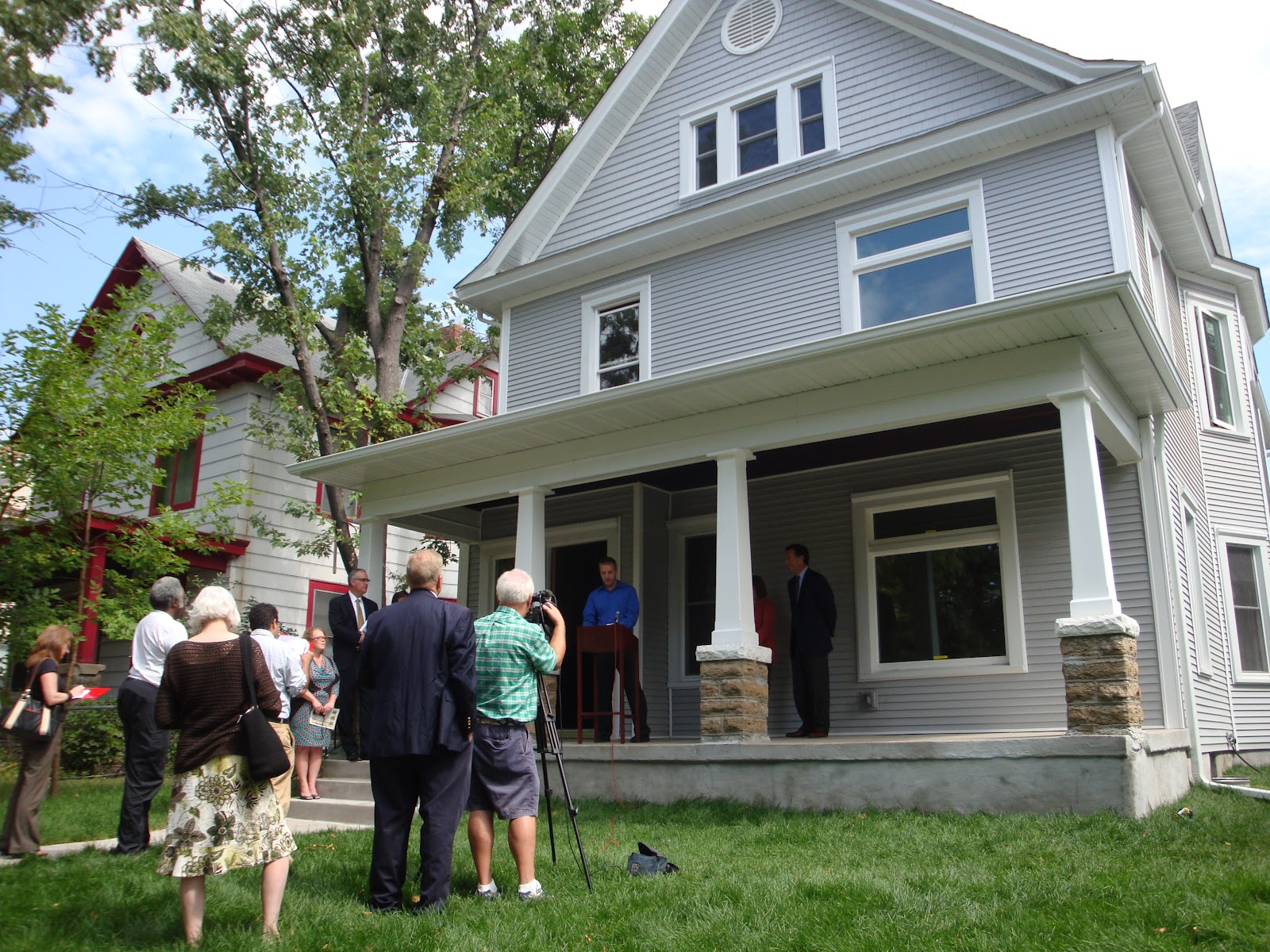
The new initiative was announced August 28 at a press conference at a home in North Minneapolis that has recently been remodeled by Neighborhood Housing Services of Minneapolis:

L-R Glennis Ter Wisscha (Neighborhood Housing Services of Minneapolis); Dave Kvamme (Wells Fargo); Jason Peterson (Community Neighborhood Housing Service)
CLICK TO ENLARGE
Recently Remodeled Home in North Minneapolis (Press Conference)
CLICK TO ENLARGE

The program will include a free event for potential homebuyers on Friday and Saturday, September 7th and 8th at the Minneapolis Convention Center, (Hall A) from 10am – 7pm.  At the event, buyers who are interested in purchasing a home in either of the cities can work with a member of the Homeownership Advisors Network and other housing counselors to see if they qualify for any of the down payment grants available through the NeighborhoodLIFT program – up to $15,000 – even if they haven’t yet chosen a home.  There will also be opportunities for buyers to preview featured homes for sale in Minneapolis and St. Paul neighborhoods.  Consumers who would like more information about the homebuyer workshop or to register, visit www.neighborhoodlift.org.


Here’s some additional information about the NeighborhoodLIFT down payment assistance program:

  • Grant amount up to $15,000 for down payment assistance for the purchase of a primary, owner-occupied residence in either Minneapolis or St. Paul (surrounding cities are not eligible).
  • The grant has a 0% interest rate and is forgivable 20% each year for five years (after the fifth year of continued residence, the entire amount is forgiven).
  • Household income cannot exceed 120% Area Median Income
  • Purchaser does NOT have to be a first-time buyer
  • Homebuyer education is REQUIRED (Home Stretch certificate is accepted if the course was taken prior to 8/28/2012.  After 8/28/2012, the Home Stretch certificate must be issued by either Community NHS or Minneapolis NHS).
  • This down payment assistance can be used with OTHER down-payment programs (speak with a Homeownership Advisor at Community NHS or Minneapolis NHS for more details)
  • Most importantly: this down payment assistance can be granted REGARDLESS of who you choose to use as your primary lender (you do NOT have to have a first mortgage loan with Wells Fargo to qualify for the assistance).


Friday, May 20, 2011

New Mortgage Disclosure Forms

Share your opinion with the Consumer Financial Protection Bureau


It’s not very often that the general public gets to weigh in on items that will affect the entire mortgage industry. Recently, the Consumer Financial Protection Bureau (CFPB) released drafts of a new one-page (two-sided) mortgage disclosure form and is asking for YOUR opinion. The final form will combine the two mortgage disclosures that are currently required -- the federal Truth in Lending Act (TILA) mortgage disclosure and the Real Estate Settlement Procedures Act (RESPA) Good Faith Estimate -- into one two-page form, down from the current five pages.

While these forms are covered in-depth in the Home Stretch workshop, they certainly can be confusing for the average homebuyer, and the CFPB is asking the general public to offer their opinion on which of the two is easier for you (or your customers) to understand.

Both versions show the key loan terms like the interest rate, the monthly loan payment, any closing costs and taxes. Borrowers can quickly see how much they'll be paying per month, and, if the loan is adjustable, how those payments might change throughout the life of the loan.

Interestingly, the form also shows the Annual Percentage Rate (APR) paid over a five-year period, along with the amount of principal you will have paid off in five years (real equity).

The CFPB will be working on these forms until July of 2012, but over the next few months, the agency will be revising and re-uploading the form(s) on its site based on the input it receives.

So… go vote! Let your opinion be heard. Then come back and let us know which one you prefer in the comments. The two forms are available here.

When comparing the forms, we recommend that you focus on what information mortgage lenders and/or brokers should share with homebuyers to make the process as easily understood and transparent as possible. Remember… our goal at the Minnesota Home Ownership Center, and of our lender and real estate partners, is successful homeownership. Which form do you think will best help potential buyers in that respect?

Are you a Minnesota resident thinking of buying your first home? Do terms like TILA, RESPA and GFE sound like a foreign language? You can learn more about these, and many more, terms, the mortgage loan process and the best steps to follow to be a successful homeowner by taking a Home Stretch workshop. For more information, click here.

Wednesday, May 4, 2011

Dangerously Unprepared

Buying a home without Home Stretch


Even after all of the news about the dangers associated with purchasing a home without being fully prepared, it appears as though the message still isn’t getting out to potential homebuyers. According to a newly-released survey from Zillow Mortgage Marketplace, a surprisingly high number of people don't understand the home buying process, especially the information about obtaining a mortgage, and may be making poor financial decisions as a result.

Those surveyed answered basic questions about mortgage information and terminology wrong almost half of the time. Forty-four percent of buyers admitted that they are not confident in their knowledge of mortgages or the mortgage process!


Other findings include:


  • About 77% of prospective homebuyers did not clearly understand what factors are involved in determining a mortgage interest rate, believing that annual income is an important determinant.
  • More than one-third (34%) of the respondents did not understand that lender fees are negotiable and that they vary by lender. They believe lenders are required by law to charge the same fees for credit reports and appraisals.
  • More than one-third (37%) of prospective home buyers who were polled believe that pre-qualifying for a loan means they have secured financing. The reality is that "pre-qualification" is used to describe an earlier step in the process when a lender or Homeownership Advisor approximates how much you can afford, but does not pull your full credit report or request any sort of documentation to verify the information you provide. A pre-qualification is NOT a pre-approval.

Before you start the process of making what may be the LARGEST PURCHASE IN YOUR LIFE, we highly recommend that you participate in a Home Stretch workshop. This is a class for potential homebuyers that is recognized nationally as a proven tool for preparing Minnesotans to be successful homeowners. There is an entire section of the Home Stretch workshop dedicated to fully understanding mortgage loan terminology, how to shop for a loan, how credit affects loan payments and how to avoid being taken advantage of when choosing a loan.

Year after year, Home Stretch participants report that help with understanding mortgages and the loan process was the MOST HELPFUL part of the workshop. In fact, NINETY-FIVE PERCENT of Home Stretch participants report that their participation in Home Stretch will help in the process of buying a home, and 98% would recommend the workshop to someone else. (For more information about consumer satisfaction with Home Stretch, view the most recent report here).


Are you thinking of purchasing a home in Minnesota? You can learn more about the mortgage loan process - - and the entire home buying process by taking a Home Stretch workshop. For more information, click here.

Wednesday, March 30, 2011

Buying a Home With Someone?

One of the best reasons to take a Home Stretch workshop is to be able to fully understand all of the terminology that is related to homeownership.  This is especially important when closing on a property that you are buying with someone else... as a couple, family or just friends purchasing a property together.

In Minnesota when two or more people buy a home together they can choose joint tenancy or tenancy-in-common. The Minneosta Home Ownership Center has created a new Fact Sheet to provide an overview of both types of ownership.

Here's how it works:


Joint Tenancy
Joint tenancy is when two or more people own equal shares of a home. If an owner dies, ownership is transferred to the remaining owner(s).This is called the “right of survivorship.”


Tenancy-in-Common
Tenancy–in-common is when two or more people own a home. Ownership does not have to be equal. If an owner dies, ownership is transferred to the person(s) named in their will.

Tenancy-in-Common Agreement


When choosing tenants-in-common, a tenancy-in-common agreement is recommended. Agreements are usually written with the assistance of a real estate attorney.


The agreement generally includes:
  • The agreed to percentage of ownership for each owner.
  • A formula to determine the amount of each owner’s payment.
  • Consequences for an owner not paying their portion of the mortgage.
  • How property maintenance and the cost will be shared.
  • Restricting the sale or transfer of ownership without the consent of the other owner(s).
  • Acceptable reasons and the price to buyout an owner.
  • What happens if an owner declares bankruptcy or in the event of a death.

To view this new fact sheet, and other helpful information for first-time buyers, visit the Center's website here.

If you're thinking of purchasing your first home... and would like to learn more about the types of homeownership and lots of other important information, you should take a Home Stretch workshop! 

Thursday, March 3, 2011

Fannie Mae's 2010 National Housing Survey

Fannie Mae has released the findings of their latest National Housing Survey that polled homeowners and renters between October and December, 2010.

The Survey has some interesting facts and figures to digest:  
  • 65% of Americans believe that it’s a good time to buy a home. This is almost unchanged from last January, but down five points (from 70%) that thought it was a good time to buy in June (2010).
  • Just like last year… A large majority (78%) believe home prices have either bottomed or will rise over the next year. However, there have been price declines in most major markets throughout the U.S. over the past year (including here in Minnesota), meaning 78% of people polled in 2010 were wrong.
  • The percentage of those polled who believe buying a home is a safe investment has fallen six points to just 64 percent since last January’s report.

The Center believes that potential homebuyers should ALWAYS be cautious when buying their first home – and be VERY careful when hearing things like “Now is a good time to buy!” and “Housing is a safe investment!”… the “Crowd” may not aways be right.


When renters were asked why they wouldn’t purchase a home… their responses are revealing:

  • The #1 reason cited, by almost half of the respondents, was that they believe their credit was not good enough to obtain a mortgage.
  • In addition, the #2 reason, cited by 47% (multiple answers were allowed)… was that they don’t think they can afford both a mortgage and the upkeep of a home.

While the Center applauds renters that approach the idea of homeownership cautiously… there is a way to KNOW if your credit is good enough… and KNOW exactly how much you can afford to purchase – or if purchasing a home is even a good fit for you: We recommend you take a homebuyer workshop! In Minnesota, the state's premier homebuyer (pre-purchase) education curriculum is known as Home Stretch. To learn more about Home Stretch, and other services for homebuyers, visit the Center's website here.

For more information about the National Housing Survey and to see the complete report, visit Fannie Mae's website, here.  

Wednesday, February 9, 2011

Payment Changes With a Fixed-Rate Mortgage

I have a fixed-rate mortgage... but my payment just went up.  How can that be?

This is one of the most common questions the Center receives from recent homebuyers who are wondering what's happening...
  • Are they being taken advantage of by their lender?
  • Has their loan been confused with someone elses?
  • Did they sign the wrong paperwork at closing? 

Using the "Ask A Question" form on the Center's website... several homeowners asked this question, leading us to create a video podcast of the possible answers:


This short video, just six minutes long, gives an overview of how a monthly mortgage payment can change - even if someone has a fixed-rate mortgage.

This is the kind of information that is covered, in-depth, in the Home Stretch workshop.  If you're thinking about buying your first home, think Home Stretch first.

If you've already bought your home... and have a question about your mortgage or your payment, feel free to contact a local housing counselor today!

Monday, January 24, 2011

NEO: The Matrices Have Been Updated

The Minnesota Home Ownership Center strives to provide information and resources that will assist Minnesotans begin, and maintain, home ownership. 

In November of 2009 we introduced our "Entry Cost Assistance Matrix" that outlines the down payment programs, closing costs assistance and other funds available to first-time buyers in Minnesota. We've now updated the Matrix for the first quarter of 2011! To view the most recent version of the matrix, click here.

The Matrix is organized geographically, which allows readers to quickly find the area of the state that they are most interested in.

As a quick reminder, funding for down-payment assistance and entry-cost help is FLUID. The information may change. Please contact a program administrator to see if funds are available, and, if not, if there is a waiting list that you or your client can use to access funds in the future.

In addition, the Center has also updated its "Affordable Loan Product matrix".   The Affordable Loan Product Matrix is designed to inform housing counselors and industry professionals of affordable mortgage loans and programs available to their clients.

Home ownership is expensive and first-time buyers should never base their home-buying decision on a down-payment program or access to a specific mortgage. There are MANY other factors when deciding whether home ownership is right for YOU or not. Before purchasing YOUR first home... take a Home Stretch Workshop (pre-purchase education workshop) to learn what's involved, and speak with a non-profit Housing Counselor to see if you might qualify for any down-payment assistance or other first-time buyer programs. For more information, click here.

Thursday, January 6, 2011

Mortgage Success: Does the Bank Matter?

New study from Ohio State University finds banking locally can impact mortgage success.

Researchers from the John Glenn School of Public Affairs at Ohio State University have found that low-income homeowners who received a mortgage from a local lender were less likely to default on their loans than those homeowners who borrowed from a more distant bank or mortgage company, even when these borrowers received the same type of mortgage product.
The researchers studied loan performance of more than 20,000 homebuyers who purchased homes AFTER the foreclosure crisis began (between 2005 and 2008). They examined the location of bank branches relative to where the homebuyers purchased their homes and found that higher-risk homebuyers with loans from banks with branches close to their new homes (less than 10 miles) were significantly less likely to default on their mortgages.

Can a personal relationship affect loan repayment?
As with large, non-local banks and many mortgage brokers, most local lenders base their lending decision on ‘the numbers’ like credit scores. HOWEVER, many local lenders place more weight on other factors, such as length of current employment, and whether you make regular deposits in a savings account.

“This kind of information may give a more complete picture of whether a person can really afford a mortgage, particularly for higher-risk borrowers,” said Stephanie Moulton, one of the researchers from Ohio State University.

“Some of the local bankers told me they won’t even look at a credit score until they have talked to an individual and determined if they think he or she can make the payments.”, she added.

The researchers believe that if there’s an existing business/personal relationship, the borrower may feel more obligated to make their payments, and the banks may provide more education and information to the borrowers, equipping them to be better homeowners.

The Minnesota Home Ownership Center truly believes that arming potential homebuyers with the ‘education and information’ that Moulton mentions is THE KEY to long-term successful homeownership. There is an entire chapter of the Home Stretch curriculum dedicated to helping potential homeowners navigate the mortgage loan process… including how to choose a lender and a loan product. For more information, visit the MN Home Ownership Center’s website, here.


Wednesday, December 15, 2010

Shopping For A Mortgage

According to a LendingTree/Harris Interactive survey released on December 14th, about 40% of recent home buyers obtained JUST ONE mortgage loan quote before purchasing their home.

According to the survey of just over 1,300 buyers, 70 percent of borrowers find shopping for a mortgage frustrating, citing the complexity of the terms as the number one reason people choose not to 'mortgage shop'.

The survey also reveals that although buyers recognize that their mortgage choice is a decision that will affect them financially for the next 15 – 30 years (or more!), nearly three-quarters (72 percent) of homeowners spent less than eight hours shopping for their home loan. Even more shocking? One in ten spent less than TWO MINUTES shopping for their loan.

In Minnesota... buyers have the opportunity to take a Home Stretch workshop, the homebuyer workshop recognized nationally as a proven tool to prepare homebuyers to be successful homeowners.  There is an entire section of the Home Stretch workshop dedicated to fully understanding mortgage loan terminology, how to shop for a loan, how credit affects loan payments and how to avoid being taken advantage of when choosing a loan.

In a forthcoming report from the MN Home Ownership Center, Home Stretch participants reported that help with understanding mortgages and the loan process was the MOST HELPFUL part of the workshop.  One more fact (just in case you're not convinced yet)... NINETY-FIVE PERCENT of Home Stretch participants reported that their participation in Home Stretch will help in the process of buying a home.

Are you thinking of purchasing a home in Minnesota?  You can learn more about the mortgage loan process - - and the entire home buying process by taking a Home Stretch workshop.  For more information, click here.

Monday, October 4, 2010

HECAT Funding Awards Announced

The State of Minnesota is unique in that we are the only state in the country with a dedicated pool of funds that provides financial support to eligible non-profit organizations to deliver a variety of homebuyer/homeowner education, counseling and training services to Minnesotans. This dedicated pool is known as HECAT (The Homeownership Education, Counseling and Training Fund).

Some of the valuable services that are funded through HECAT include:
  • Pre-purchase education and counseling (Home Stretch),
  • Post-purchase education and counseling,
  • Home equity conversion counseling (Reverse Mortgages) and
  • Foreclosure counseling
Funds for HECAT come from four funding partners that are fully invested in ensuring that Minnesotans have access to the education and counseling tools necessary to achieve successful home ownership:
Each of the four funding partners not only contribute financial resources they also actively participate in the grant-making process.

Additional information about HECAT can be found here.

A complete list of organizations that have been granted HECAT funds for the 2010-2011 program year is available here. (PDF Document)


Friday, September 17, 2010

Fannie Mae's National Housing Survey

Fannie Mae has released the latests findings of their National Housing Survey that polled homeowners and renters between June 2010 and July 2010. These findings were compared to a similar survey released in April  (See the Center's April 22 blog post about that here). 

The Survey has some interesting facts and figures to digest:

Regarding purchasing a home:
  • 70% of Americans believe it’s a good time to buy a home - even with all of the issues we've been hearing about in the housing industry.  This number is up from 64% of respondents from the earlier survey conducted in January.
  • A large majority (78%) believe home prices have either bottomed or will rise over the next year, up from 73 percent in January.
Here's a great quote from the press release of the survey:
“Although most Americans believe that home prices have bottomed, they are adopting a much more cautious approach toward buying,” said Doug Duncan, Vice President and Chief Economist, Fannie Mae.

The Center believes that potential homebuyers should ALWAYS be cautious when buying their first home.  That's why we offer the state's premier homebuyer (pre-purchase) education curriculum, Home Stretch.  To learn more about Home Stretch, and other services for homebuyers, visit the Center's website here.

The survey has interesting information about CURRENT homeowners as well:
  • 22% of mortgage holders (homeowners) said that they have reduced their mortgage debt “significantly” over the past year, while 27 percent say they have reduced their non-mortgage debt significantly. (!!)
  • Nearly 20% of homeowners know someone who has strategically defaulted, or stopped making their mortgage payments even when they could afford to make them.
The survey also has interesting data about housing attitudes from minority groups including African Americans and Latinos. 

For more information about the survey and to see the complete report, visit Fannie Mae's website, here.  

Monday, August 30, 2010

Taking On Time Magazine

In the world of blogging, there's a traffic-generating trick known as 'punching upward' (or fighting upward, punching above your weight class, etc.) - in which a blog picks a fight with a highly trafficked blog or media source, in order to gather some of that blog's traffic in the ensuing battle.  While this is certainly not the primary goal of this post - we won't complain if we see an uptick in traffic as we take on Time Magazine and their most-recent cover story "Rethinking Homeownership, why owning a home may no longer make economic sense."

The actual title of the article is even more menacing "The Case Against Homeownership". 


Homeownership has been proven, over and over, to be the NUMBER ONE driver of wealth creation for low- to moderate- income homebuyers over time.  (The key being over TIME).  Even Barbara Kiviat, the article's author, understands this fact:

Homeownership has done plenty of good over the decades; it has provided stability to tens of millions of families and anchored a labor-intensive sector of the economy.

The article... which is only available in an abridged version online states that:

But the dark side of homeownership is now all too apparent: foreclosures and walkaways, neighborhoods plagued by abandoned properties and plummeting home values, a nation in which families have $6 trillion less in housing wealth than they did just three years ago.


The problem has never been - and never will be - homeownership. 

The problem stems from one of preparation, education and expectations.  BEFORE deciding to purchase, homebuyers need to fully understand the financial implications, the risks and the responsibilities of homeownership - and the information needs to come from an unbiased source... not a marketing/sales pitch from someone who has a financial stake in the decisions the homebuyer makes.  Homeownership should never be seen as a short-term vehicle to wealth creation.

In Minnesota, THE source of unbiased information about the home buying process and homeownership is HOME STRETCH.  A Home Stretch Workshop will help you become an informed, prepared consumer. The workshop offers objective, practical information to help you:

  • Determine your REAL financial situation
  • Understand credit, credit issues, and how credit affects the costs of homeownership
  • Decide what type of mortgage is best for your needs
  • Select the right home for your family
  • Understand the loan closing process
  • Find special programs just for first-time homebuyers

And, even though we are the HOMEOWNERSHIP CENTER... we consider it a success if someone takes a HomeStretch workshop, or speaks with a pre-purchase counselor, and decides that homeownership is not right for them.  Homeownership is NOT right for everyone... and being a successful homeowner isn't easy.

To find out more, visit the MN Home Ownership Center's website, here.

Tuesday, August 24, 2010

Census Bureau Releases Housing Data

This is actually a couple of days old... but I thought our readers might be interested in knowing that the U.S. Census Bureau has released the 2009 American Housing Survey, The Report covers statistics about apartments, single-family homes, manufactured housing, new construction and vacant housing units throughout the country.

According to the new survey... the nation's homeowners paid a median of $1,000 in monthly housing costs in 2009, compared with $808 for renters. However, renters usually paid a higher percentage of their household income on these costs than did owners (31 percent compared with 20 percent).

A wide range of specific topics is covered in the survey, such as the presence of air conditioning, crowding, housing costs, special living services offered to older residents, type of heating fuel used, cost of utilities and size of the home... and even 'subjective' information like satisfaction with the neighborhood. Of course, the survey also covers the demographic characteristics of the housing units' occupants.

Here are some interesting facts from the report:
  • Thirty-two percent of owner-occupied units were owned free and clear,
  • 66 percent had a regular and/or home equity mortgage and 2 percent had only a line-of-credit.
  • The most important consideration for recent movers in choosing their homes was financial (28 percent), followed by room layout/design (15 percent) and size of home (10 percent). Furthermore, the most common reasons recent movers had for choosing their neighborhoods were convenience to job (20 percent), convenience to friends or relatives (14 percent), look/design of neighborhood (10 percent) and the house itself (10 percent).
  • Ten percent of communities had secured entrances, with the likelihood somewhat higher (15 percent) in new communities. [Ed... Really? 10% of all single-family homes are in gated communities??]

Data from this survey (In MS Excel format) are available at the national and regional level, and for inside and outside metropolitan statistical areas, and urban and rural areas.

Remember... The Minnesota Homeownership Center’s goal is SUCCESSFUL homeownership. If you’re thinking of buying your first home… the Center is here to help. Workshops for first-time buyers are available throughout the state and counselors (one-on-one meetings) are also available. If you’d like to learn more, visit our website here.

Friday, May 14, 2010

Foreign Born Homeownership Rates in Minnesota

MN Compass has recently released a ton of great demographic information about foreign-born populations in Minnesota. The data includes information on age, length of time in the US, income and, especially important to the work we do here at the MN Home Ownership Center, information on rental and homeownership rates.

Below you can see data that we’ve consolidated from MN Compass on the homeownership rates among Minnesota’s immigrant groups. We’ve sorted the list by size (population number).


Click image to enlarge


Interestingly… every one of the groups saw gains in their homeownership rate from 2000 through 2008. Some of these gains are significant. Although the Liberian population is relatively small in Minnesota, they saw a 50% increase in their homeownership rate. The Mexican population, Minnesota’s largest foreign-born group, saw an increase of close to 30%.

It will certainly be interesting to see how/if the homeownership rates change after this year’s census.

The Minnesota Homeownership Center’s goal is SUCCESSFUL homeownership. If you’re thinking of buying your first home… especially if you are new to the process in the U.S. or might prefer assistance in your native language, the Center is here to help. Workshops for first-time buyers are available in more than 5 different languages throughout the state and counselors can work with interpreters in ANY language. If you’d like to learn more, visit our website here.

Thursday, May 6, 2010

Creative? Help Us Name Our Network of Counselors

As regular readers know, the MN Home Ownership Center coordinates the statewide network of home ownership education and counseling organizations.  (Pre-purchase education and counseling, foreclosure prevention services, post-purchase education and counseling, reverse mortgage services, etc.)

For years, we've simply referred to this network as "The Network" or "The Statewide Network of Housing Counseling and Education Organzations".  Neither of these are very descriptive... or easy to say, for that matter.

CALLING ALL CREATIVE TYPES!!  The Center is seeking creative and innovative ideas for a name to bring recognition to the Center’s network of home ownership education and counseling organizations.  Something that can be branded and easily understood by MN homeowners and future homeowners!

Submit your ideas to win prizes, contribute to successful homeownership in Minnesota, and win our eternal gratitude.  Fame and fortune await! (OK... maybe I'm exagerating a bit).  Let your creative juices flow and send your suggestions to: ed@hocmn.org or in the comment section below.

For more information about the contest and what we're looking for, click here. (PDF)

To learn more about the Center and its network partners, click here.

The deadline for entries is Friday, May 14, 2010.

Friday, April 23, 2010

Home Maintenance Expenses

As we've mentioned before... one of the most important steps to becoming a successful homeowner is efficient and effective money management.  In fact, understanding finances and credit is a large segment of what is taught in the Home Stretch workshop.

Part of successful money management is the ability to save and prepare for FUTURE homeownership-related expenses.  The general 'rule-of-thumb' is to save between 1-2% of your home's purchase price EVERY year for future maintenance and upkeep on the home.  (Eventually, even brand new homes will need repairs and replacement of major systems like the furnace, A/C, roof, etc.).

Fixr.com has put together an AMAZING infographic showing how Americans typically spend their money on home improvement based on data from The American Housing Survey, the US Census, The National Bureau of Economic Research, and the Joint Center for Housing studies at Harvard.

According to their data, Americans spent $42 billion dollars on home improvements in 2009 - and that's down from the $49 billion they spent in 2008.


Here's their graphic:

(Click image to enlarge - it's HUGE)
SOURCE: Here

According the website Bundle.com, monthly expenses related to home maintenance and upkeep cost, on average, $363.00 per month, or $4,356.00 per year.


Click image to enlarge
Source:
Here


Are you currently considering purchasing your first home? There are LOTS of factors to consider, including making sure that you are ready, willing and able to undertake the financial responsibility of upkeep and maintenance on your home. The first step to SUCCESSFUL homeownership should be a short visit with a Housing Counselor or taking a Home Stretch workshop. For more information on buying your first home in Minnesota, click here.
 

Disclosure: Fixr.com is a website that links homeowners looking to remodel with contractors.  The MN Home Ownership Center has no affiliation with Fixr.com.  Bundle.com is a website that compiles data on spending patterns in the U.S.  The MN Home Ownership Center has no affiliation with Bundle.com